

The Kryptis malware recently attempted to spread across the infrastructure of one of our clients, an SME operating in the legal sector. Thwarted by our teams, this threat followed modern malware attack patterns. Difficult to detect with traditional tools, this client case highlights the limitations of perimeter defense models.
In this post, we explain, step by step, how we successfully blocked this cyberattack leveraging the synergy of: SIEM UEBA / Threat Intelligence / Human Expertise.
The Kryptis malware
The Reveelium SIEM UEBA first detected Dark Web access attempts in our client's logs.
Verdict: the endpoints were indeed infected, and malware was identified: Kryptik (also known as Packed, Krypt, Cryptic, Crypt, Kryptis…).
It is a Trojan horse malware that, once installed, can be remotely controlled by the attacker (Command & Control). It is used to exfiltrate sensitive information such as usernames, passwords, or critical files. It can also perform screen and keystroke logging (keylogging), monitor network traffic, execute malicious payloads, and transmit all collected data to an attacker-controlled remote server.
Detection details
For this client, as with many others, the initial vector of the attack was a phishing email.
Standard security tools (antivirus, firewalls) are incapable of detecting this type of malware or ransomware attack on their own. ITrust teams analyzed the client's logs and identified the early propagation signs within the SME's network.
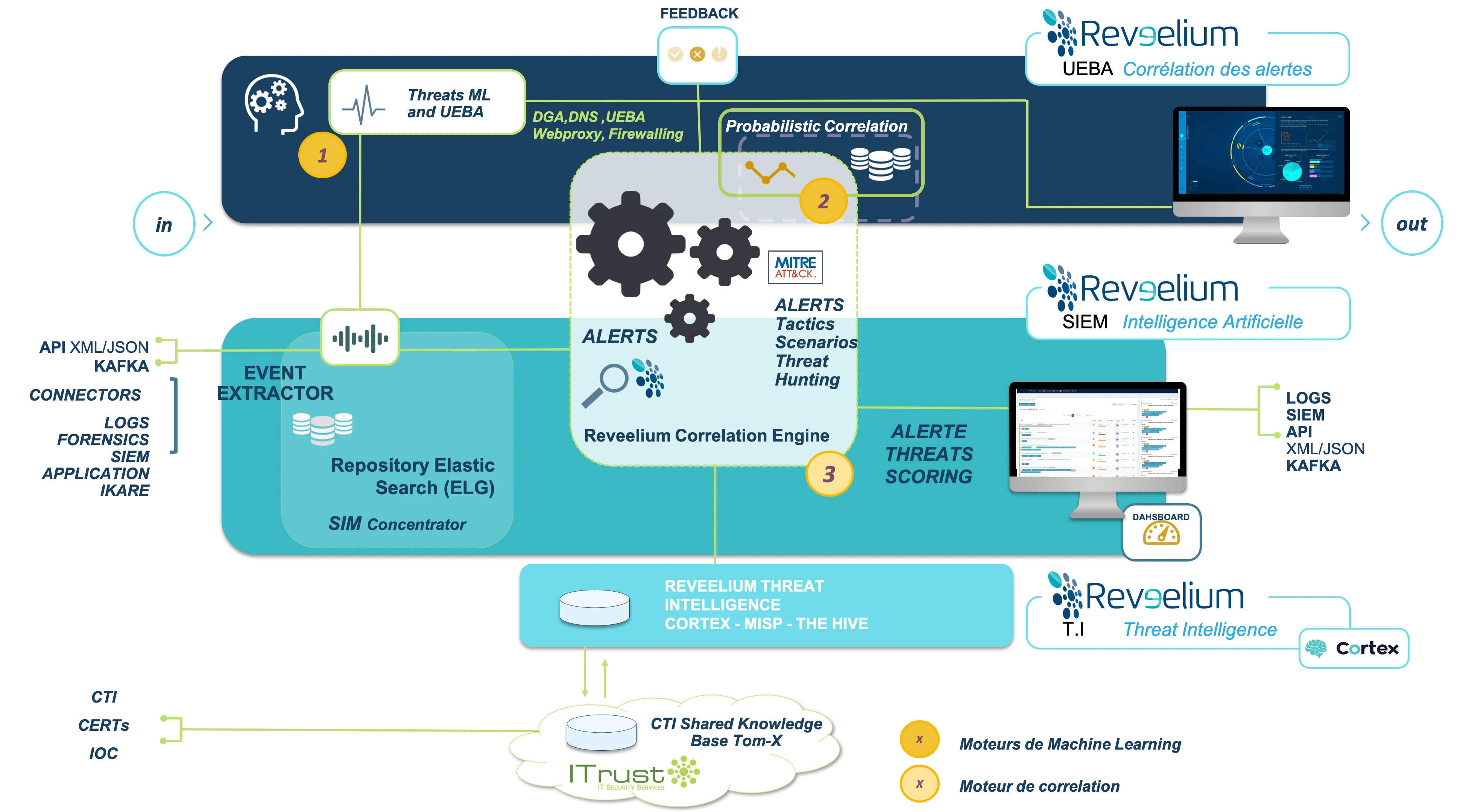
The attack was detected and neutralized thanks to two Reveelium engines:
1/ DGA detection (abnormal URL) powered by Machine Learning
2/ Correlation with our Threat Intelligence feeds, which identified communication with a known malicious server.
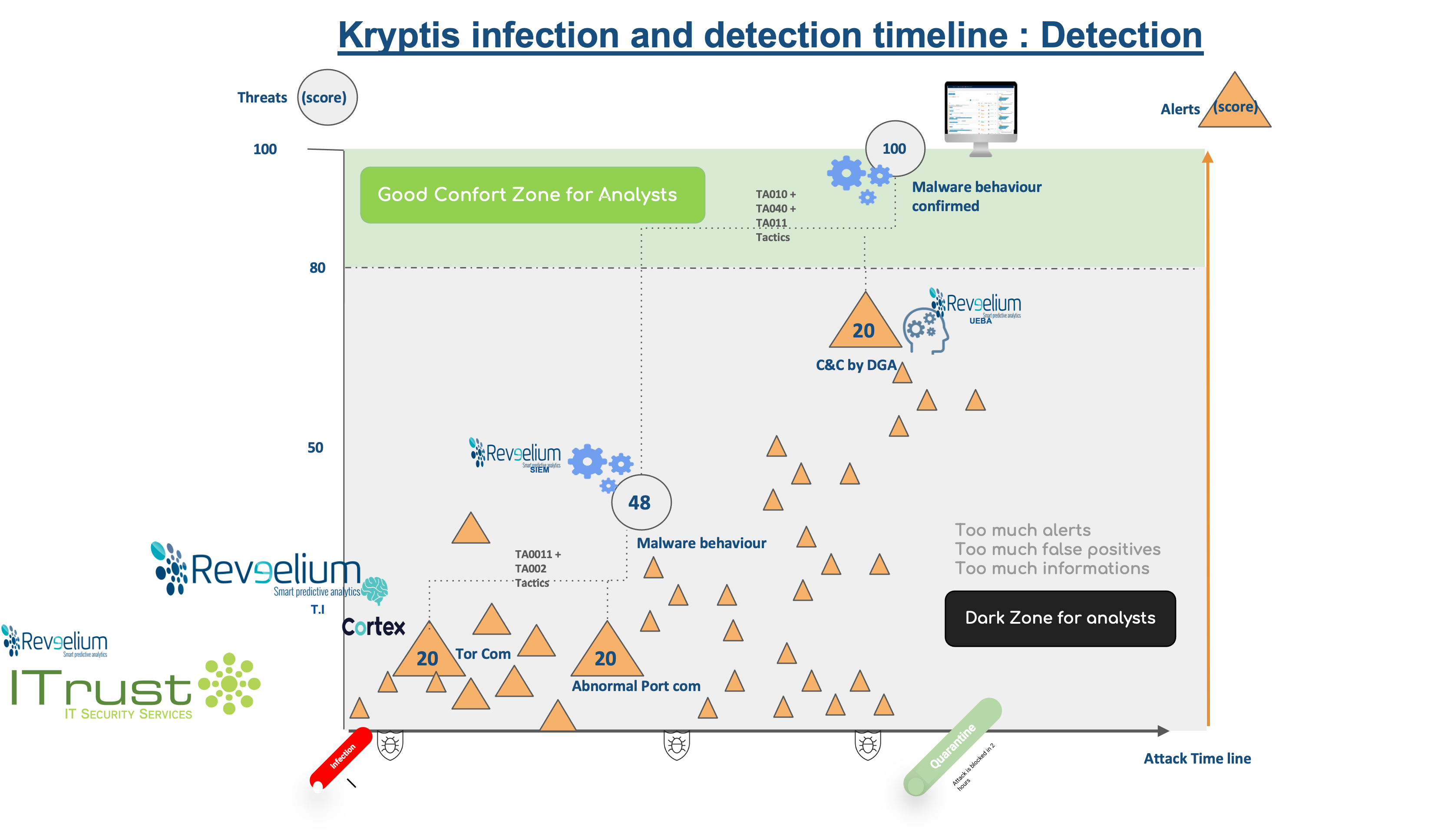
Identified across 3 different points within the monitored scope, the malicious activity triggered multiple alerts. This chain of correlated alerts enabled Reveelium SIEM to aggregate them into a single high-score threat (100) and promptly notify SOC analysts (detection based on the Cyber Kill Chain).
This represents the defense-in-depth doctrine advocated by ITrust. An isolated EDR or firewall cannot establish the correlation between multiple disparate events distributed across the network and over time.
The cross-source log correlation is what makes this detection possible.
AI ensures effective alert prioritization and drastically reduces false positives that typically burden analyst workflows.
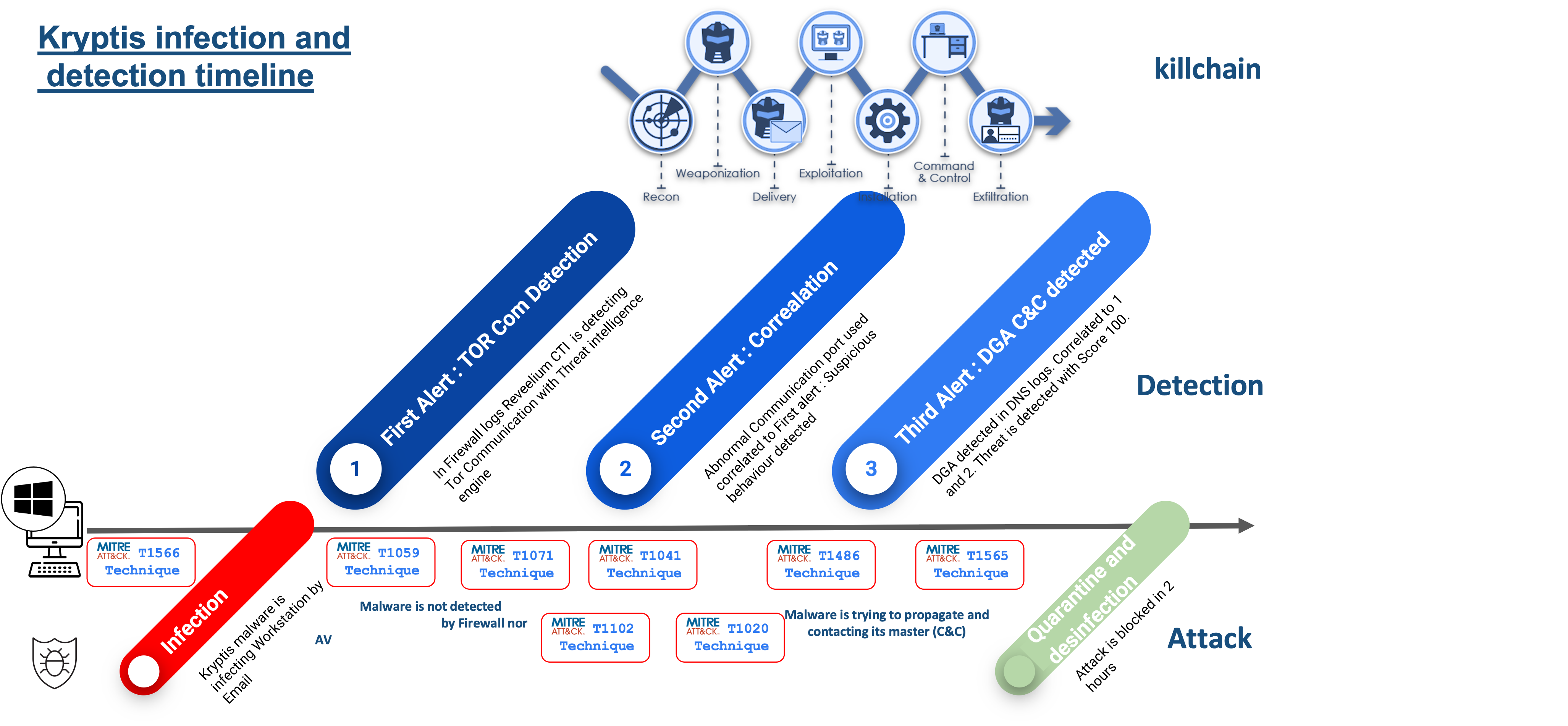 Timeline: infection and detection of Kryptis
> Phase 1: suspicious Dark Web access
Reveelium's Threat Intelligence engine triggers an initial alert for communication with a malicious IOC. Reveelium is interconnected with approximately fifty global CERTs and detects the infected client PC communicating with a TOR network IP address via logs ingested from the client's firewall.
The alert is scored at 20/100 (no threat is generated at this stage). It is not escalated and thus not processed by default by the SOC / Blue Team. Setting a higher threshold for this type of alert would generate excessive false positives.

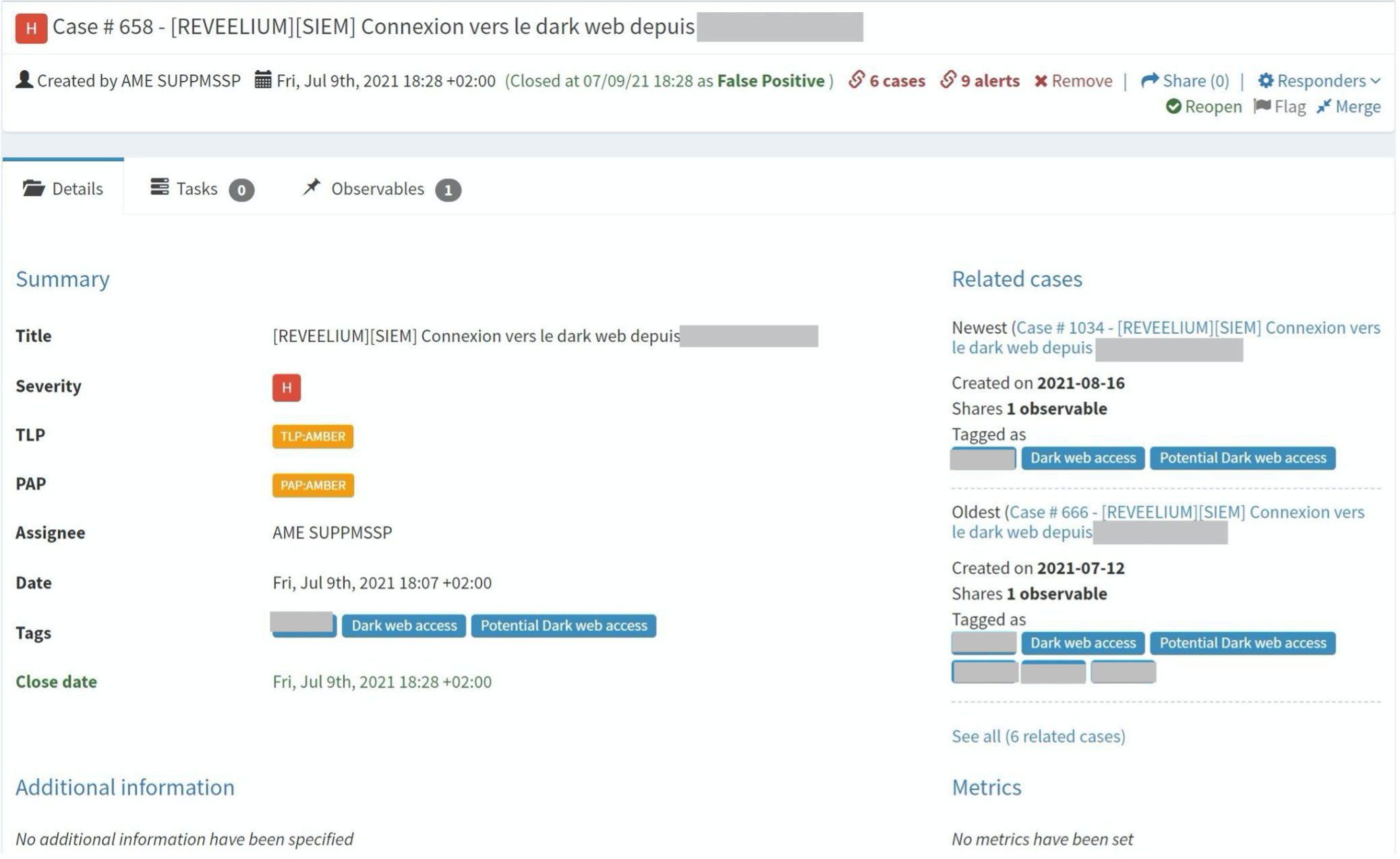
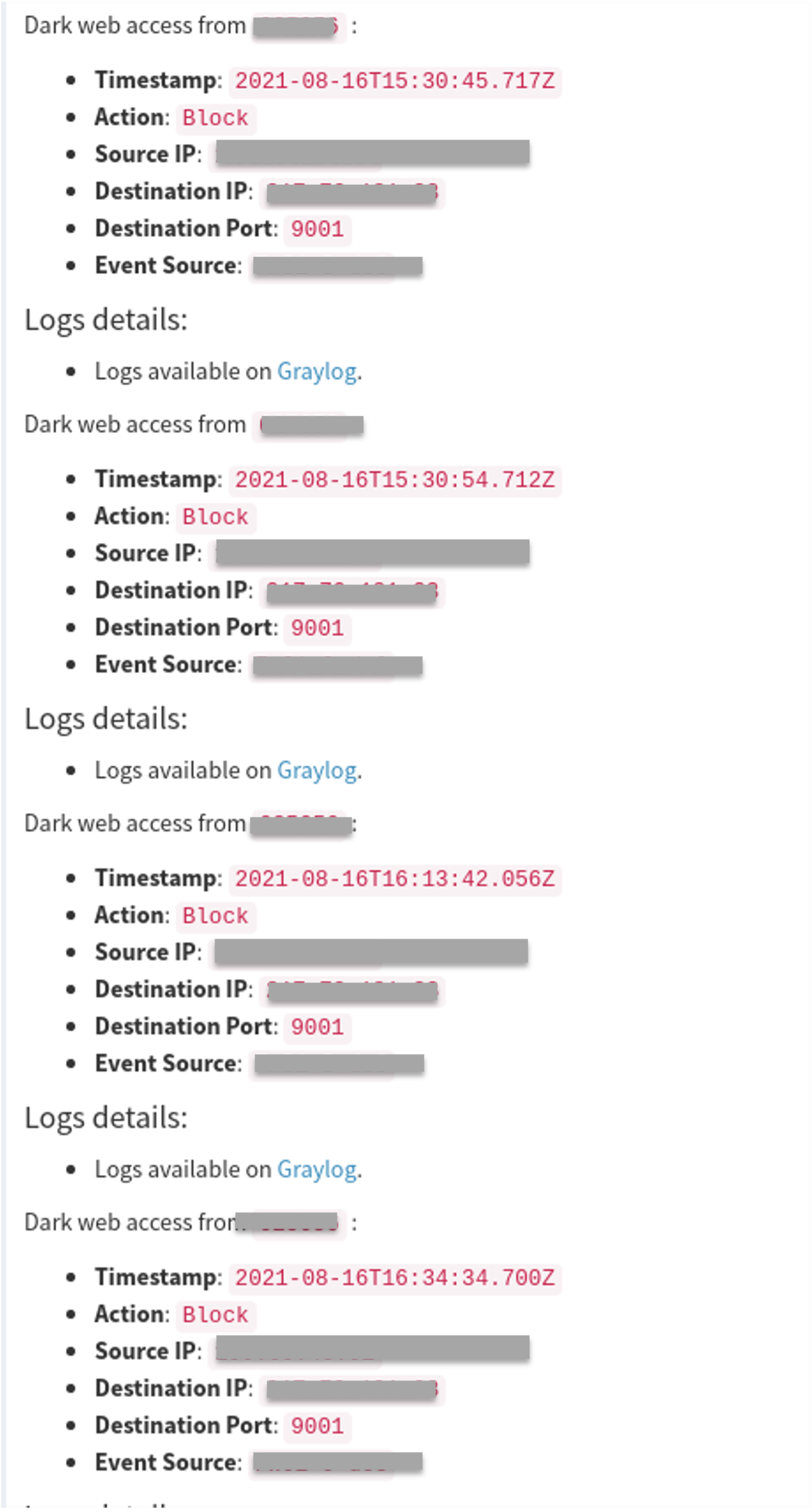
> Phase 2: communications on high-risk ports
Concurrently, the Reveelium SIEM correlation engine links this alert to active communications over high-risk ports (a correlation rule built and deployed by the ITrust team to detect malware attack techniques mapped to specific MITRE ATT&CK tactics).
> From two alerts scored at 20/100, we identify a potential threat scored at 50/100.
While the situation is potentially concerning, experience shows that immediate escalation is not required at this stage.
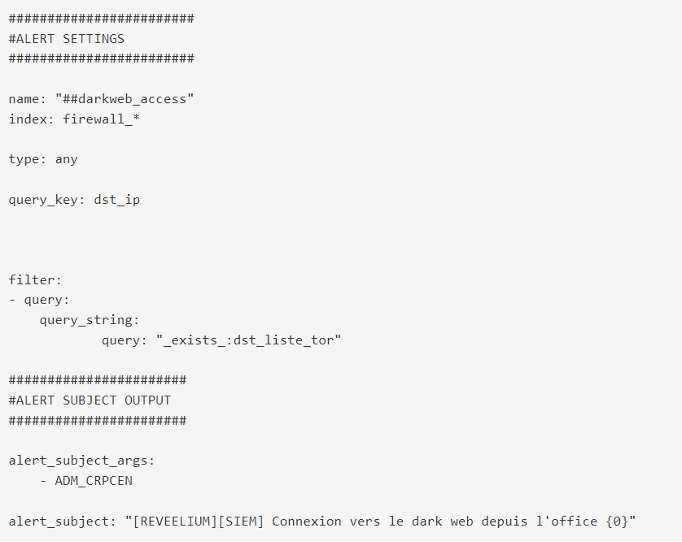
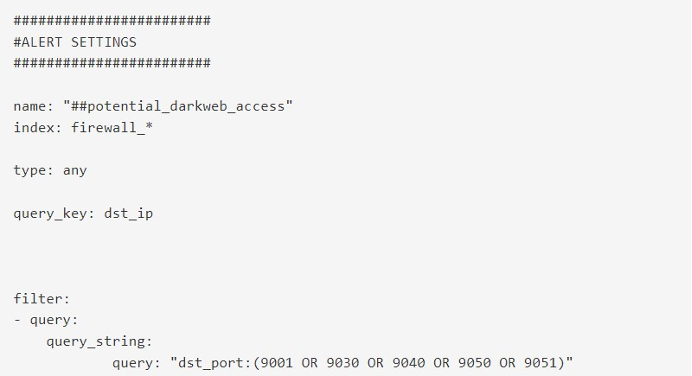 Dark web connection rule
> Phase 3: DGA (malicious URL) & C2
Simultaneously, Reveelium UEBA inspects DNS queries ingested from Active Directory or DNS logs. A DGA is detected (queries to a malicious URL tied to a C2 infrastructure). This detection relies on an ITrust proprietary algorithm engineered to spot algorithmic URL generation patterns.
In this instance, Kryptis established contact with a central C2 server (the "botmaster") to exfiltrate harvested data and pull down a larger payload to execute subsequent malicious stages.
Only artificial intelligence was capable of detecting this C2 communication.
DGA score: Reveelium scores this event at 48/100. Taken alone, this could be a false positive.
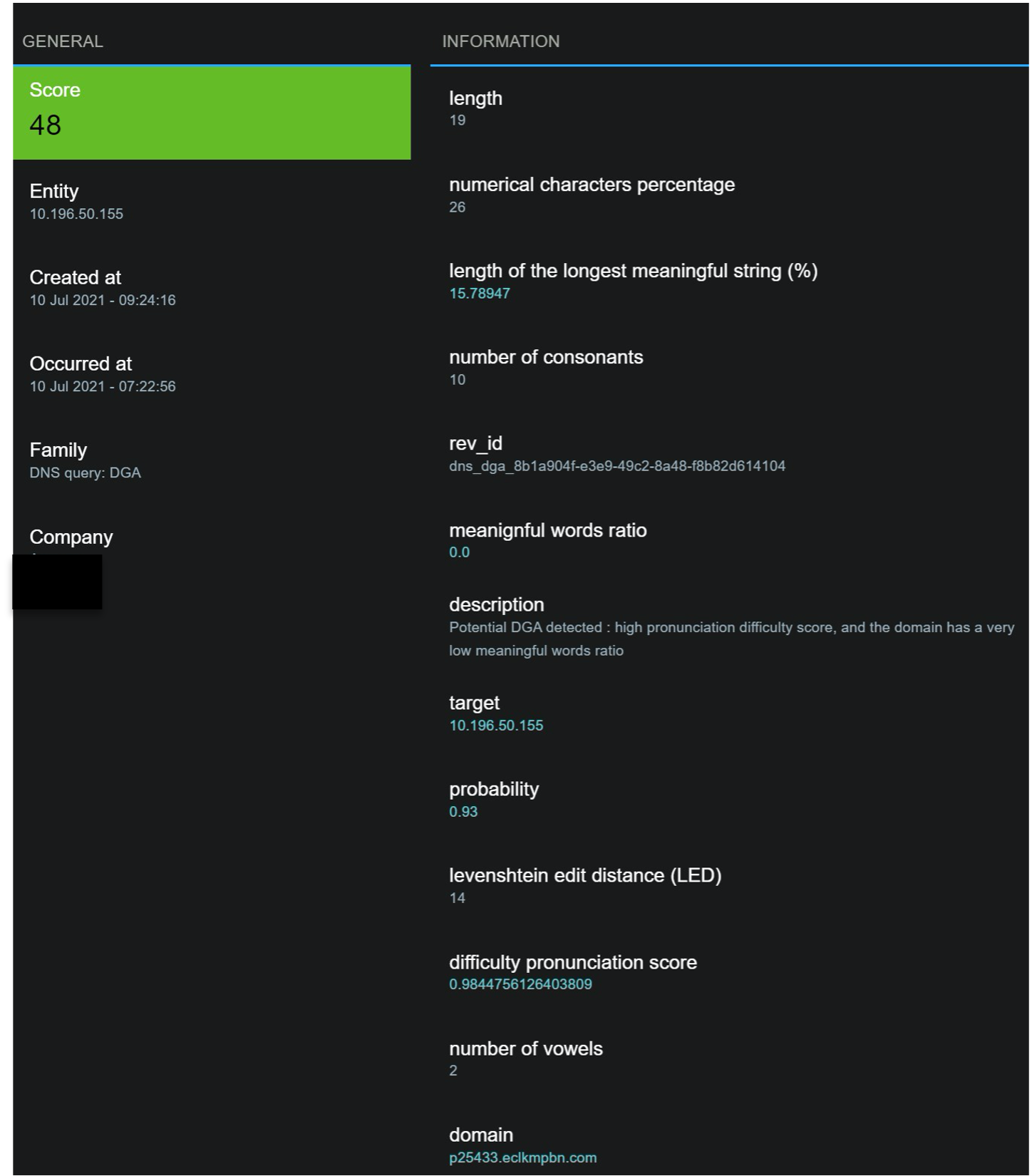
Reveelium interface: view of a DGA-related alert
Technique used (MITRE ATT&CK framework)
– Application Layer Protocol T1071
Adversaries may communicate using application layer protocols to bypass network monitoring and filtering by blending in with legitimate traffic. Commands sent to the remote system, and the corresponding outputs, are encapsulated within standard client-server protocol exchanges.
– Web Service T1102
Adversaries may leverage legitimate external web services to relay data to and from a compromised system. Established websites and social media platforms used for C2 can provide substantial operational cover, as hosts within enterprise environments often communicate with them routinely prior to any breach.
Relying on widespread services, such as those provided by Google or Twitter, enables threat actors to conceal traffic amidst regular background activity. Web service providers routinely deploy SSL/TLS encryption, granting adversaries an added layer of obfuscation.
The key to detection:
Evaluated in isolation, these three alerts (Dark Web, high-risk ports, and DGA) would likely go unnoticed. Environments generate vast volumes of such alerts daily, and the overhead required for Tier 1 SOC analysts to qualify each individually would be unsustainable.
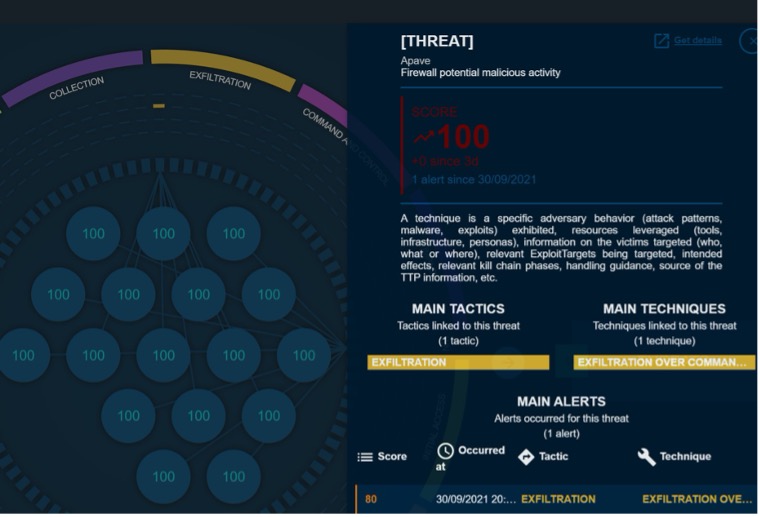
Reveelium Threats Visualization (Firewall)
However, Reveelium's Threat Hunting capabilities—built upon intelligent scoring and contextual aggregation—allow us to present analysts with a single, prioritized critical threat scored at 100/100 for immediate remediation.
In the case of this Kryptis threat, our teams were able to immediately clear up any doubts and confirm the suspected compromise of a machine through the Graylog logs.
A critical incident ticket was sent to the client for notification. In parallel, an in-depth investigation was conducted by ITrust's L2/L3 SOC analysts to identify the malware and the scope of the compromise.
Feedback from the client and their IT service provider confirmed our assessment: a Kryptis-type malware was attempting to spread across the information system.
We subsequently recommended isolating the machine. The client confirmed the action.
Reveelium FW detection
Further investigation was carried out across all logs and in coordination with the IT manager to verify whether the malware had propagated.
Reveelium FW detection
The FAR and L3 (CSIRT) teams verified that no data exfiltration had taken place.
Fortunately, in this case, detection and remediation were swift, and no data was stolen.
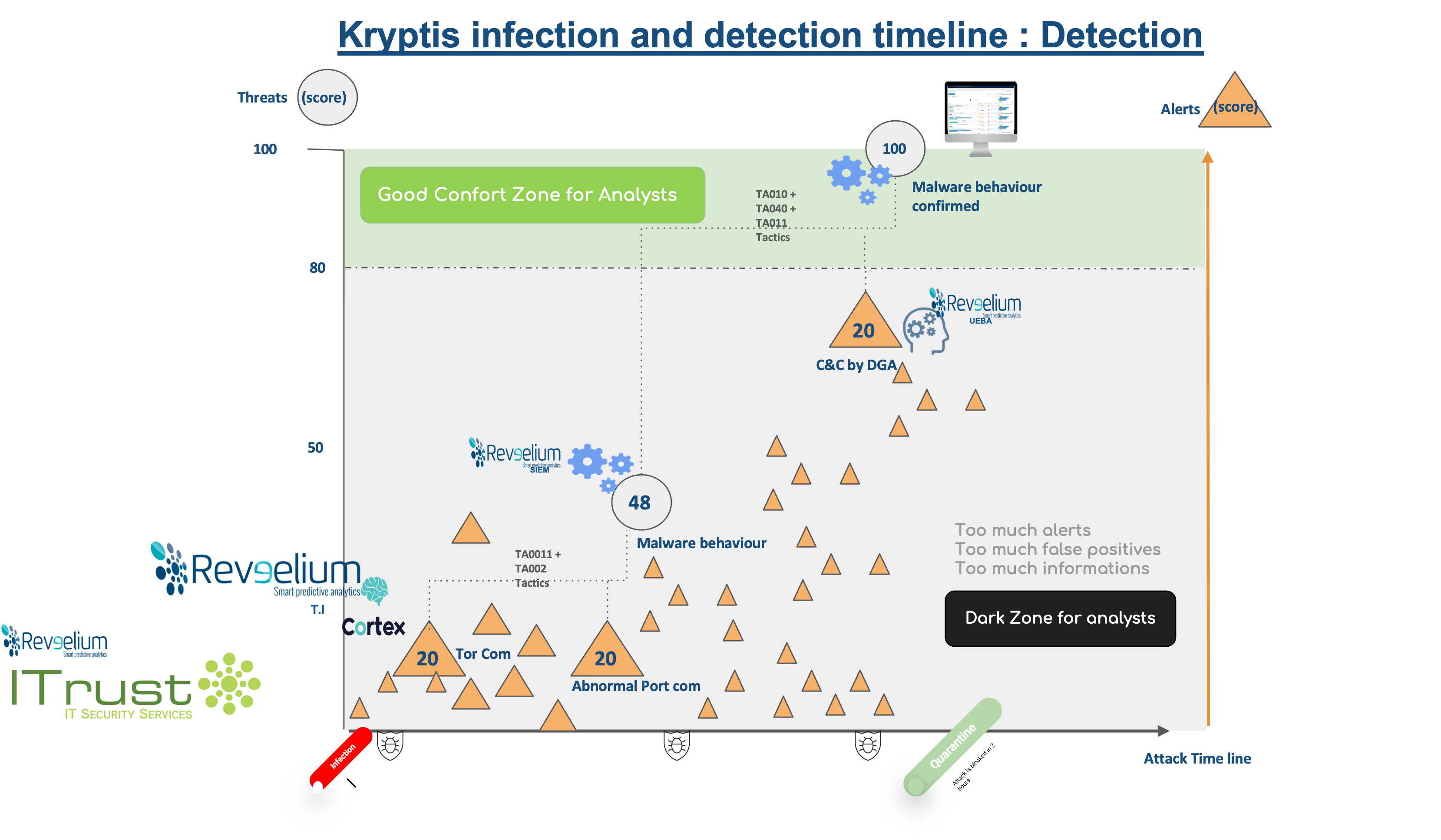
In summary:
We found this case study particularly relevant, as the attack carried out would have left most technologies on the market without any defensive capability.
This case illustrates the value of leveraging diverse detection sources beyond standalone EDRs or NDAs (network traffic analyzers).
Without AI to correlate alerts, this multi-vector attack would have generated an overwhelming volume of alerts and false positives, making timely detection extremely difficult.
Likewise, the analysis time required by a Blue Team would have been far too long to prevent malware propagation had the detection methodology not been grounded in the MITRE ATT&CK matrix, natively integrated into the Reveelium UEBA SIEM.
€500,000 in potential losses – This is the estimated impact for this client had the attack succeeded (data loss, ransom demands, regulatory fines). The indirect damage is even harder to quantify: loss of customer trust following a data breach, severe reputational damage, etc.
This represents a substantial cost for an SME and further reinforces the need for a defense-in-depth strategy, regardless of your organization's size.
Probable MITRE ATT&CK path identified in this incident:
1. [TA0001] Tactic: Initial Access
Initial Access consists of techniques that use various entry vectors to gain an initial foothold within a network. Techniques used to gain entry include targeted spear-phishing and exploiting vulnerabilities on publicly accessible web servers. Footholds gained through initial access may provide persistent access—such as through valid accounts and external remote services—or limited access subject to credential rotation.
a. [T1566] Technique: Phishing
Adversaries may send phishing messages to gain access to victim systems. All forms of phishing are delivered electronically via social engineering. Phishing can be highly targeted, commonly referred to as spear-phishing. In spear-phishing campaigns, a specific individual, company, or vertical is targeted by the adversary. More broadly, adversaries may deploy untargeted phishing, such as high-volume malware spam campaigns.
2. [TA0002] Tactic: Execution
Execution consists of techniques that result in adversary-controlled code running on a local or remote system. Techniques that execute malicious code are often combined with techniques from other tactics to achieve broader objectives, such as network reconnaissance or data exfiltration. For example, an adversary may use a remote access tool to run a PowerShell script that performs remote system discovery.
a. [T1059] Technique: Command and Scripting Interpreter
Adversaries may abuse command and script interpreters to execute commands, scripts, or binaries. These interfaces and languages provide native ways to interact with computer systems and are standard across multiple platforms. Adversaries can leverage these technologies in various ways to execute arbitrary commands. Commands and scripts can be embedded in initial access payloads delivered to victims as decoy documents, or downloaded as secondary payloads from an established C2 server. Adversaries may also execute commands via interactive shells.
3. [TA0011] Tactic: Command and Control
Command and Control consists of techniques that adversaries use to communicate with systems under their control within a target network. Adversaries typically attempt to mimic legitimate, expected traffic to evade detection. There are multiple ways to establish C2 infrastructure, offering varying degrees of stealth depending on network architecture and existing perimeter defenses.
a. [T1071] Technique: Application Layer Protocol
Adversaries may communicate using application layer protocols to bypass network monitoring and filtering by blending in with legitimate traffic. Commands sent to the remote system, and the corresponding outputs, are encapsulated within standard client-server protocol exchanges.
b. [T1102] Technique: Web Services
Adversaries may leverage legitimate external web services to relay data to and from a compromised system. Well-known websites and social media platforms used as C2 channels provide significant stealth, as hosts within an enterprise network typically communicate with these services regularly. Leveraging widely used services, such as those provided by Google or Twitter, enables adversaries to blend in with baseline network noise. Furthermore, web service providers routinely enforce SSL/TLS encryption, granting adversaries an additional layer of obfuscation.
4. [TA0010] Tactic: Exfiltration
Exfiltration consists of techniques adversaries use to steal data from your network. Once data has been gathered, adversaries often package and compress it to avoid detection during removal. This may include compression and encryption. Techniques for exfiltrating data typically involve transmitting it over the command and control channel or an alternative path, often with bandwidth throttling or chunk size limitations to avoid threshold alerts.
a. [T1041] Technique: Exfiltration Over C2 Channel
Adversaries may steal data by exfiltrating it over an existing command and control channel. The stolen data is encoded within normal communication traffic, utilizing the same protocol as operational C2 communications.
b. [T1020] Technique: Automated Exfiltration
Adversaries may exfiltrate data, such as sensitive documents, using automated routines once the collection phase is complete. When automated exfiltration is deployed, it is often paired with other transfer techniques to move data off the network, such as exfiltration over a C2 channel.
5. [TA0040] Tactic: Impact
Impact consists of techniques adversaries use to disrupt availability or compromise integrity by manipulating critical operational and business processes. Impact techniques may include data destruction or tampering. In certain scenarios, business processes may appear operational while having been maliciously altered to serve the adversary's objectives. These techniques are often employed to achieve the adversary's ultimate objective or to cover up a data breach.
a. [T1486] Technique: Data Encrypted for Impact
Adversaries may encrypt data on target endpoints or across multiple systems on a network to disrupt the availability of system and network resources. They typically attempt to render stored data inaccessible by encrypting files on local and network-attached drives while withholding the decryption keys.
b. [T1565] Technique: Data Manipulation
Adversaries may insert, delete, or alter data to distort external results or conceal malicious activity. By manipulating data, threat actors can compromise business processes, mislead analytical assessments, or hinder administrative decision-making.
Would you like to learn more about our solutions?
> Discover Reveelium, our UEBA SIEM powered by AI and Threat Intelligence engines – Certified "Utilisé par les Armées Françaises" (U.A.F.) by the French Ministry of the Armed Forces
> Discover ITrust's Managed SOC, combining advanced proprietary tooling with the expertise of our cybersecurity analysts