


Are you ready? Are you protected against technology capable of instantly decrypting your bank transactions and reading your encrypted conversations?
As cybercrime continues to evolve and intensify, the most critical threats organizations must prepare for are intrinsically linked to the rise of quantum computing. This promising—yet feared—technology, based on quantum physics rather than standard electronics, could revolutionize cybersecurity and pose unprecedented challenges to current cryptographic systems.
What is a quantum attack?
A quantum attack uses the principles of quantum mechanics to compromise the security of cryptographic systems. Unlike classical computers, which use bits as the fundamental unit of information (0 or 1), quantum computers use qubits (quantum bits), which can exist in multiple states simultaneously due to the phenomenon of superposition. Furthermore, the phenomenon of entanglement allows qubits to become interdependent in such a way that the state of one can instantly affect the state of another, even at a distance.
These unique properties therefore allow quantum computers to execute certain algorithms much faster than classical computers— speeds that could reduce calculations, which would currently take several million or even billions of years, to just a few seconds or minutes.
From Classical to Quantum: Cryptography That Stands the Test of Time
Cryptography, which is essential to information security, has evolved from ancient times to the present day and plays a key role in modern cybersecurity. However, quantum computing threatens to disrupt these established techniques, posing new challenges for cryptography.
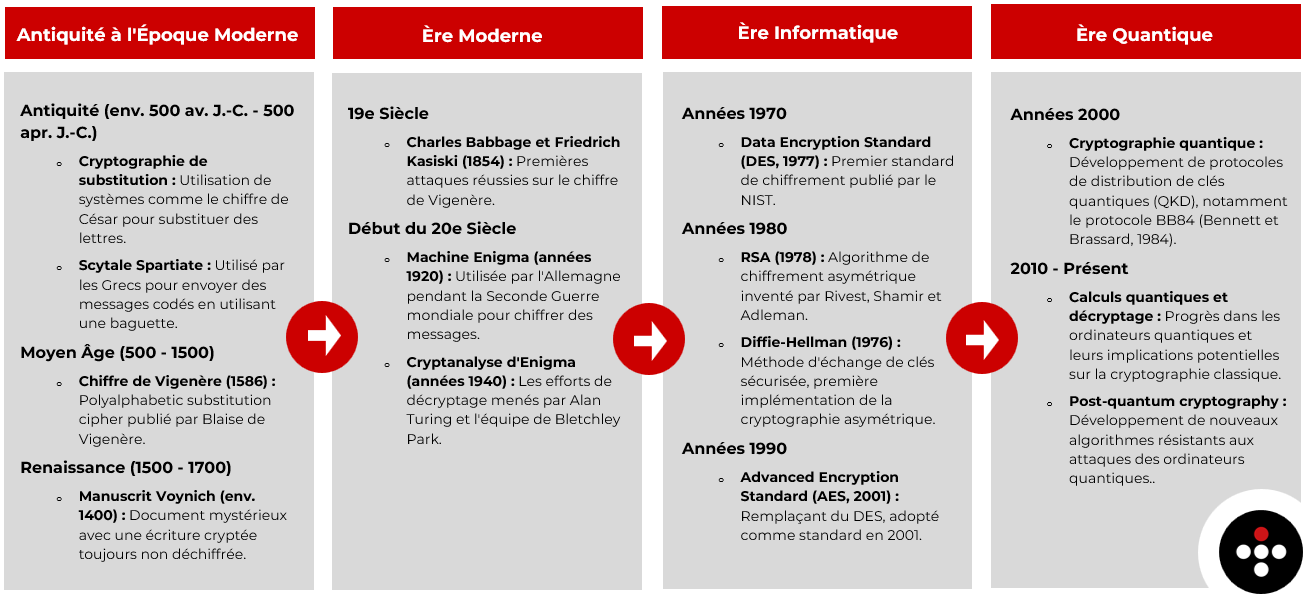
These key dates mark the major milestones in the evolution of cryptography, from its classical origins to the challenges posed by modern quantum technologies.
Symmetric Encryption vs. Grover's Algorithm
Replacing the DES, the AES (Advanced Encryption Standard) is now the most widely used encryption standard, offering enhanced security through keys of varying lengths (128, 192, or 256 bits). Although symmetric algorithms are less vulnerable to quantum attacks than asymmetric algorithms, they are not completely immune.
In fact, Grover's algorithm provides quadratic acceleration for searches in unstructured databases. This algorithm can significantly reduce the time required to perform a brute-force search for encryption keys.
Asymmetric Encryption vs. Shor's Algorithm
Asymmetric encryption, or public-key cryptography, is a fundamental pillar of modern cybersecurity. It enables secure communications over unsecured networks by using a key pair: a public key to encrypt data and a private key to decrypt it. Asymmetric encryption systems such as RSA, DSA (Digital Signature Algorithm), and ECC (Elliptic Curve Cryptography) rely on the complexity of mathematical problems such as factoring large numbers or the discrete logarithm. These problems are known to be difficult to solve using classical computers. However, Shor’s algorithm is a quantum algorithm capable of factoring integers exponentially faster than the best known classical algorithms.
The Quantum Threat to Cybersecurity
A comparison of classical and quantum algorithms highlights an inevitable transition toward new security standards. Classical cryptographic algorithms, while still robust, exhibit potential vulnerabilities when faced with the capabilities of quantum computers. Organizations must begin assessing their readiness for their implementation now.
According to the Global Risk Institute’s report on the quantum threat (2023), quantum computers will reach maturity by 2037. Nearly every aspect of information systems will need to transition to post-quantum encryption, including network devices, servers, endpoints, smart devices, operating systems, applications, connected devices, IoT, and OT. This timeline is particularly short for organizations to prepare, prioritize, and execute the complete migration of their digital environments and digitized business processes.
There are other possible solutions for strengthening security against quantum threats. One short-term approach is to increase the key sizes for certain algorithms. Another solution involves combining classical and post-quantum cryptographic systems in hybrid protocols, which can provide a smooth transition to quantum-secure systems. Finally, companies must begin now to assess their vulnerabilities and implement plans to transition to post-quantum cryptographic solutions.
At the same time, malicious actors are already exploiting the “Harvest now, decrypt later” attack strategy. By collecting data on a massive scale, they are banking on the fact that at least one piece of valuable or critical data will be included in the batch, and that they will soon be able to decrypt it using quantum computers.
Conclusion
Quantum computers pose enormous challenges to the security of current cryptographic systems but represent a major advance in the field of computing. The scientific community and cybersecurity professionals must work together to develop robust solutions that can withstand the capabilities of future quantum computers. The early adoption of post-quantum cryptography and the implementation of hybrid protocols are crucial steps in ensuring the long-term security of sensitive data.