

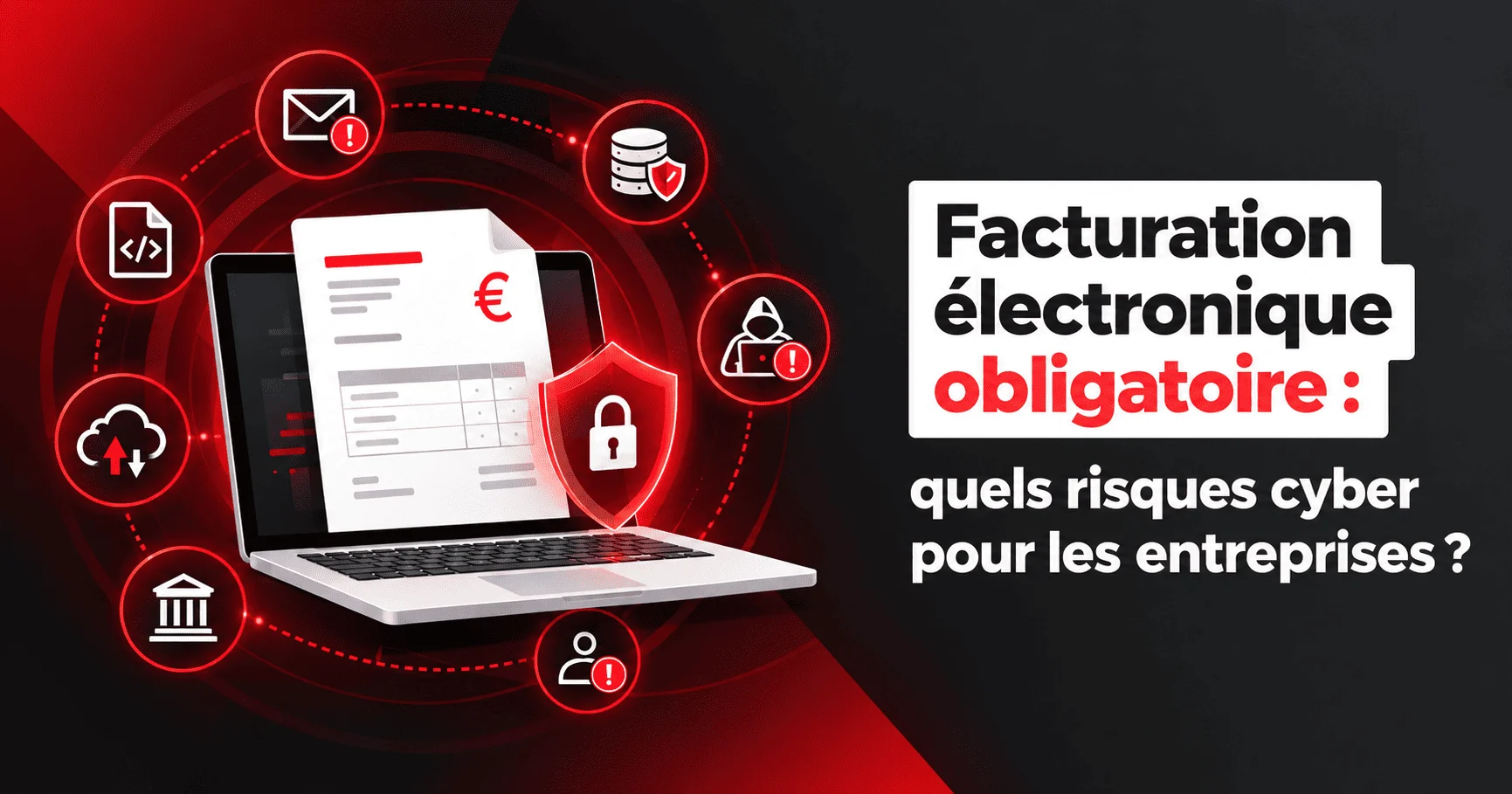
Since September 1, 2026, the electronic invoicing reform has come into effect in France. All VAT-registered businesses must now be able to receive electronic invoices, while large enterprises and mid-caps must also issue them in this format. SMEs and micro-enterprises will join this framework starting September 1, 2027. Behind this regulatory shift lies a genuine cybersecurity challenge.
From now on, relevant B2B invoices transit via partner dematerialization platforms (PDP), directly or through compatible solutions.
For businesses, this translates to a potential multiplication of interactions: ERP / accounting software → API or connector → certified platform → recipient's platform → client or supplier IT system
To these stages is added data transmission to the tax administration. Certified platforms transmit data from invoices exchanged between businesses to the DGFiP concentrator. For transactions outside the scope of e-invoicing (B2C sales, cross-border exchanges), e-reporting takes over: companies submit transaction data and, for certain services, payment data.
The invoice thus becomes a data stream integrated into the IT system. Its security depends on the entire chain: identities, workstations, applications, APIs, infrastructure, and service providers. A secure platform is not enough if the account accessing it is compromised or if the ERP feeding it is vulnerable.
Here are six key cyber points of vigilance to consider in securing these new practices.
1. Invoicing accounts
The primary attack surface revolves around digital identities. A compromised account providing access to accounting software or an invoicing platform can expose valuable information to an attacker: clients and suppliers, billed amounts, banking details, transaction history, or commercial data. This information can subsequently be used to orchestrate highly convincing attacks.
Securing access is critical: multi-factor authentication, individual user accounts, least privilege, privileged access management, and regular access reviews. Technical and service accounts used to connect different solutions must be subject to heightened vigilance.
2. Bank detail modification fraud
The widespread adoption of electronic invoicing can create a false sense of security: an invoice received through the expected channel appears legitimate. However, securing the transmission channel does not guarantee the integrity of the data entered upstream.
An attacker who has gained access to a supplier's IT system, ERP, or specific accounts can attempt to hijack the process even before the invoice is issued. Verification procedures remain essential. For instance, any change in banking details must undergo out-of-band validation with the supplier via an already established channel.
3. APIs and connectors
Invoicing automation relies on interconnection between disparate systems.
ERPs, accounting software, business applications, and platforms can communicate via APIs and connectors, which become critical assets.
An exposed API key, a compromised token, a service account with excessive privileges, or a misconfigured API can allow an attacker to access sensitive financial data or interact with the relevant systems.
Securing this new chain requires implementing best practices such as:
- inventorying APIs and connectors;
- secure management of secrets and tokens;
- limiting permissions strictly to what is necessary;
- encrypting communications;
- logging access and operations;
- regular security testing;
- monitoring for anomalous behavior.
The goal is simple: every new interconnection with the IT system must integrate into the company's overarching cyber policy.
Analysis by Guillaume, Pentester at ITrust
In the context of electronic invoicing, what are the primary security weaknesses you look to identify during an audit?
Our focus is on the security of APIs and technical accounts that facilitate data exchanges between different systems. Improper privilege management, insufficiently protected authentication keys, or exposed interfaces can allow an attacker to access sensitive financial data, or even manipulate certain data flows.
During our audits, we specifically aim to identify authentication and authorization flaws, configuration errors, and exploitable vulnerabilities. The objective is to verify that a compromised account or application cannot serve as an entry point into the entire information system.
4. New phishing scenarios
Electronic invoicing combines several attractive vectors for phishing: the novelty of the framework, regulatory deadlines, multiple platforms, and user unfamiliarity.
Employees may therefore receive malicious messages such as:
“Your electronic invoice is available”
“Your invoice has been rejected”
“Your company must activate its platform”
“Your invoicing account must be updated”
“Action required before the upcoming regulatory deadline”
The objective is to direct the victim to a fraudulent authentication page in order to harvest their credentials, deploy spyware, or compromise their workstation environment.
It may be necessary for organizations to support the rollout of electronic invoicing with an employee awareness campaign: which platform does the company use? What emails can it legitimately send? What is the internal lifecycle of an invoice? Whom should a suspicious message be reported to?
5. Supply chain impacts
Electronic invoicing reinforces interdependencies between businesses and service providers: ERP vendors, accounting software publishers, integrators, certified platforms, hosting providers, or connectors can all play a role in the chain.
A vulnerability within a third party can trigger cascading impacts across the entire chain.
A platform's registration on the list of certified platforms is a primary prerequisite. However, third-party risk analysis should encompass other criteria: data localization and hosting, encryption, authentication, certifications, vulnerability management, logging capabilities, backup policies, BCP/DRP, incident response, subcontractors, and reversibility.
The question is no longer merely "is my service provider compliant?", but above all "how do they fit into my risk management strategy?"
6. Detection of unusual behaviors
Depending on the capabilities of the solutions deployed, certain events warrant close monitoring: unusual logins to a financial account, privilege escalation, modifications to a vendor account, bulk invoice downloads, configuration changes, abnormal API call volumes, unusual service account activity, or successive authentication failures…
When correlated with events across the enterprise information system, these signals enable services like the SOC to detect suspicious behavior. The challenge lies in shifting from a platform-centric defense approach to monitoring the entire chain of trust.
Electronic invoicing delivers tangible benefits (automation, standardization, and end-to-end traceability of B2B transactions), yet it fundamentally alters the enterprise attack surface. Consequently, this transition must not be treated solely as an accounting or regulatory compliance project.
For cybersecurity teams, the rollout of the reform represents a strategic opportunity to reassess financial workflow mapping, access controls, interface security, and threat detection capabilities across these new operational paradigms.
Because behind the compliance mandate lies a question far more familiar to CISOs: who can access what, through which vectors, and are we equipped to detect abnormal behavior promptly?
Analysis by Ahmed, SOC Manager
If an attacker manages to compromise a service account or an API used for e-invoicing, what telemetry and signals enable a SOC to detect this activity?
A compromise does not always trigger a glaring alert. An adversary operating with legitimate credentials can interact with enterprise applications without tripping traditional security controls.
This is why our focus is on identifying behavioral anomalies: a service account authenticating from an unusual origin, a sudden spike in API call volumes, access to rarely queried data, or privilege modifications.
Taken in isolation, these events may not appear inherently malicious. It is their contextualization and correlation with other signals across the information system that enable accurate threat qualification.
Leveraging a SIEM/XDR platform like Reveelium, our SOC effectively analyzes these signals to detect anomalous behavior and accelerate incident investigations.
| Article Section | Source |
| Timeline / Operation | Ministry of the Economy |
| Platform Roles | DGFiP – Certified Platforms |
| Platform Security | DGFiP – List of Certified Platforms |
| APIs / Interconnections | DGFiP – Technical Specifications |
| Phishing | Cybermalveillance.gouv.fr – Phishing |
| Bank Details Fraud / Vendor Fraud | Cybermalveillance.gouv.fr – CEO/Vendor Fraud (FOVI) |
| MFA / Monitoring | ANSSI – MFA + ANSSI – Logging |