

Cyber Resilience Act: manufacturers face the September 2026 deadline and new ETSI standards

The Cyber Resilience Act (CRA) is no longer merely a legislative framework on the distant horizon. It is decisively entering its operational phase. On August 17, 2026, ETSI (European Telecommunications Standards Institute) officially initiated the approval process for 17 key European standards designed to support the implementation of the regulation. These standards cover a broad spectrum, ranging from operating systems to connected objects (IoT), tangibly defining what "security by design" entails for any product with digital elements marketed within the European Union. The pitfall of overlapping deadlines: an initial milestone before 2027 A distinctive feature [...]


Cyber Resilience Act: manufacturers face the September 2026 deadline and new ETSI standards2026-08-18T10:37:39+02:00

DORA: what concretely changes for financial sector cybersecurity and compliance in 2026

The European Digital Operational Resilience Act (DORA), which came into force on January 17, 2025, is now fully embedded within the financial sector's supervisory framework. Following a year in 2025 largely dedicated to assisting financial entities in implementing their new obligations, 2026 marks a phase of heightened supervision. Competent authorities, including the ACPR in France, are notably stepping up their audits of incident management, ICT risk management frameworks, and relationships with third-party IT service providers. DORA thus establishes a harmonized framework aimed at strengthening the digital operational resilience of entities [...]

DORA: what concretely changes for financial sector cybersecurity and compliance in 20262026-08-18T16:45:36+02:00

NIS2 in 2026: how to anticipate compliance despite transposition delays in France

As we enter the second half of 2026, the French transposition of the NIS2 (Network and Information Security) Directive remains pending. This delay compared to the initial schedule has triggered infringement proceedings by the European Commission. However, for the thousands of essential and important entities affected, waiting for the final publication of the law in the Official Journal would be a strategic mistake. The urgency is not legislative; it is operational. The trap of waiting: why ANSSI is not awaiting the law While the national legal framework is still under discussion, the National Cybersecurity Agency of France [...]

NIS2 in 2026: how to anticipate compliance despite transposition delays in France2026-08-18T10:35:44+02:00

Cybersecurity: Occitanie companies put under scrutiny

In cybersecurity, one question frequently arises: what can an attacker truly see before even attempting an intrusion? The answer can sometimes be surprising. Without privileged access, a cybercriminal can already harvest a substantial amount of information about an organization simply by observing what is exposed on the Internet. Forgotten servers, expired certificates, unmanaged subdomains, misconfigured services, or insufficient email protections: all of these represent potential entry points. It is precisely to help organizations assess this exposure that ITrust has developed Security Rating, an attack surface assessment solution [...]

Cybersecurity: Occitanie companies put under scrutiny2026-09-08T09:01:29+02:00

Cybersecurity: the French State strengthens its digital resilience

The cybersecurity posture of the French State is pivoting. Faced with the surge of cyberattacks targeting public administrations, the SGDSN and ANSSI unveiled their 2026-2027 cyber roadmap to durably strengthen the digital resilience of the State. The document sets several concrete priorities for the next two years: reinforcing cyber governance, securing access, enhancing threat detection, and preparing for post-quantum cryptography. This new strategy comes in the wake of several incidents that affected ministries and public institutions in 2025, revealing persistent vulnerabilities within certain information systems. [...]

Cybersecurity: the French State strengthens its digital resilience2026-05-25T17:19:31+02:00

Top 4 Emerging Cyber Threats in the 1st Half of 2026

The first half of 2026 confirms a profound transformation across the cybercrime ecosystem. The campaigns observed no longer rely on isolated technical feats, but rather on process industrialization, increased role specialization, and the systematic reuse of battle-tested tools. For security leaders, this evolution requires a fundamental overhaul of detection and response models. Here are the four trends identified from the Mandiant M-Trends 2026, Verizon DBIR 2026, Group-IB High-Tech Crime Trends 2026 reports, and technical analyses from our Cyber Threat Intelligence team. 1. The industrialization of data leaks and the ecosystem The [...]

Top 4 Emerging Cyber Threats in the 1st Half of 20262026-05-28T17:54:43+02:00

7 Signs It's Time to Launch a Code Audit

In many organizations, code audits are perceived as exceptional procedures reserved for critical environments or post-incident reviews. Yet, data from the OWASP Data Breach Investigations Report demonstrates that application vulnerabilities remain a major attack vector. In other words: the application attack surface has become a primary entry point for attackers. But how do you know when it is truly time to launch a code audit? Here are the indicators that should trigger action. 1. Your application is evolving fast… too fast Organizations adopting rapid delivery cycles (DevOps, CI/CD, [...]

7 Signs It's Time to Launch a Code Audit2026-04-13T16:58:33+02:00

OpenClaw: Automation revolution or Trojan horse for your data?

Following an in-depth analysis of community feedback (Reddit, GitHub, technical demos), here is an overview of OpenClaw—a tool gaining widespread attention across the AI agent ecosystem, yet raising as much excitement as it does security concerns. What is OpenClaw? Originally known as ClawdBot—renamed to avoid a trademark dispute with Anthropic's Claude model—OpenClaw positions itself as an automation framework for Large Language Models (LLMs). Unlike a conventional chat interface, OpenClaw acts as an orchestrator, enabling teams to: Automate complex workflows: [...]

OpenClaw: Automation revolution or Trojan horse for your data?2026-04-14T09:46:41+02:00

CaRe Program: Domain 2 "Business Continuity and Disaster Recovery Strategy" is now open!

Business continuity and disaster recovery are vital challenges for healthcare institutions. It is within this context of urgency and digital transformation that Domain 2 of the CaRE program operates, officially launched on July 16, 2025. Its objective: to enable public and private healthcare organizations to prepare effectively for a digital outage scenario by providing them with structured operational and financial support. Why is Domain 2 so strategic? The healthcare sector remains one of the most targeted by cybercriminals, right behind local authorities and SMBs. In [...]

CaRe Program: Domain 2 "Business Continuity and Disaster Recovery Strategy" is now open!2026-04-14T09:43:14+02:00

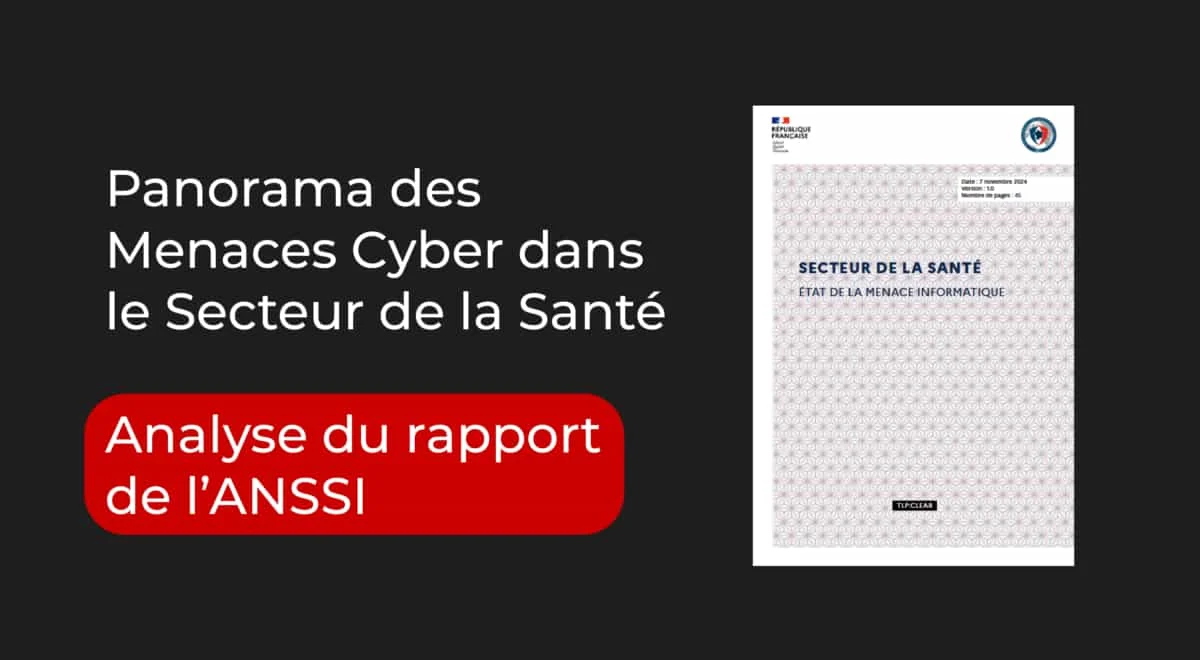
Cyber Threat Landscape in the Healthcare Sector: Analysis of the ANSSI Report (2024)

Today, the healthcare sector is one of the most exposed to cyberattacks. The criticality of infrastructures, the sensitivity of medical data, and the proliferation of connected devices make it a prime target for cybercriminals. The French National Cybersecurity Agency (ANSSI) has just published an assessment of cyber threats in this sector, shedding light on recent trends and upcoming challenges. A sector under high digital pressure ANSSI highlights the fragmentation and heterogeneity of healthcare stakeholders, making homogeneous IT systems security difficult to achieve. This sector notably encompasses: [...]

Cyber Threat Landscape in the Healthcare Sector: Analysis of the ANSSI Report (2024)2026-04-14T09:42:25+02:00
Go to Top