
#Digital Sovereignty: the challenge of the next 10 years
Op-Ed by JN Piotrowski, Founder of Itrust. May 4, 2020
ITrust is a leading company in its sector that develops disruptive software solutions designed to protect businesses against cryptolockers, data theft, malware, data leaks, and industrial espionage. Its 60 in-house employees contribute their talents to the development of the European digital industry.
I am its founding president and a committed entrepreneur.
I had some fun doing an exercise that I find instructive regarding the trickle-down effect of the economy—a principle well known to economists.
I reviewed ITrust’s financial statements and expenses and analyzed the company’s spending breakdown to determine ITrust’s impact on the local economy.
This finding adds to the debate on sovereignty in the digital economy—a fundamental principle for the years ahead.
Here are the findings.
Breakdown of ITrust's expenses and costs:
| Share of Non-Wage Expenses | 42.17% |
| Share of payroll-related expenses | 57.83% |
Investment in R&D and human resources, as well as the company’s core business; hence, a significant portion of expenses is allocated to salaries.
It should be noted that taxes (excluding corporate income tax) account for a very large portion of expenses:
| Total taxes (/total expenditures) | 24.73% |
"Taxes" include payroll taxes (Assedics and Health Insurance), employee benefits, retirement contributions, and VAT.
It should be noted that these costs are offset by the Research Tax Credit. Without it, digital companies would be unable to remain competitive on the global stage.
That said, 100% of ITrust salaries are insured in France.
Other expenses include marketing :
Most expenses and investments are made with French companies. Some U.S. software is used. Very little AdWords (paid search engine advertising).
Event planning is carried out in collaboration with companies in France or Europe.
A portion of the promotional items purchased is manufactured in China.
Advertising, bloggers, influencers, newspapers, etc. … PR agency—all services are billed in France.
Overall, very few expenses in this category are billed from abroad.
The trips are made by car (a French car—usually a Mégane ;) train (SNCF), subway (Tisseo and RATP), and exclusively by Air France (EasyJet is not allowed at ITrust ;) except in cases of complex trips where we cannot fly Air France.
Virtually 100% is therefore spent with French companies.
Rent, attorney fees, accountant fees, and statutory auditor fees are paid in France. (Except for a U.S. attorney, for whom we paid 12,000 euros in 2019)
Outsourcing: The website, graphic design, communications, subcontracted engineers, researchers, and data scientists are all based in France.
Network, Security, and IT Equipment. The PCs are Dell models purchased in Montpellier and supplied by the Americans (I recorded 80% of the invoices as originating from the U.S.)
The servers are provided by Scoplec (France) / HP (U.S.). Telecommunications in France, French security tools (confidential ;) our cloud servers are hosted by French companies such as Worldonline, OVH, etc.
Some of the software we use is American.
French cameras and French alarm systems.
No raw materials because our business involves using high-quality “brain time” to develop security products or provide cybersecurity monitoring, consulting, expert analysis, and auditing services.
No trading or extremely low trading volume.
The consumables are purchased primarily from F…. A French companycompany.
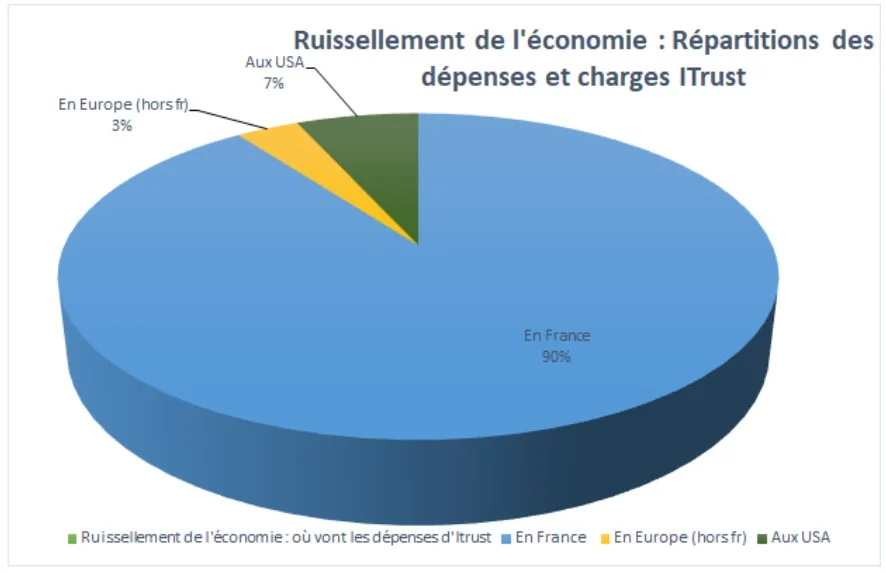
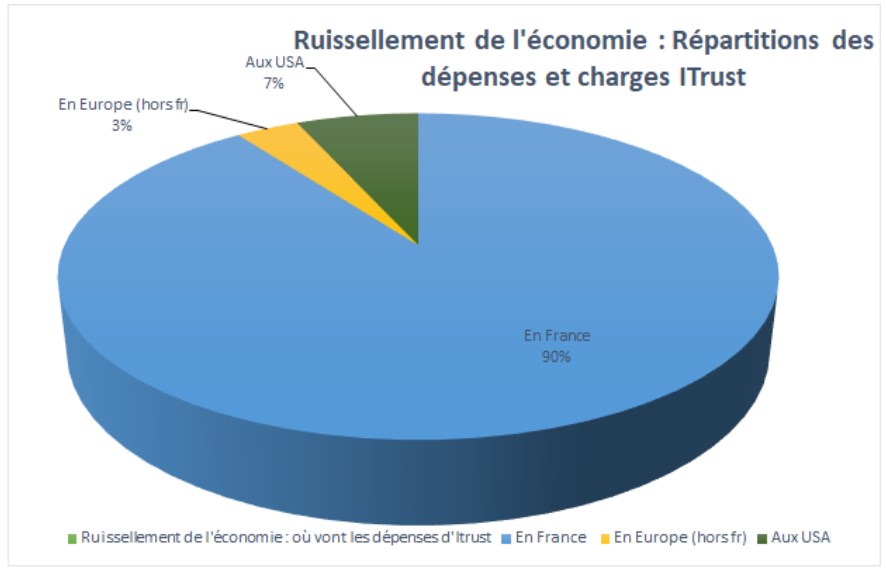
Overall, here is the breakdown of ITrust's expenses:
| Economic Trickle-Down: Where Does the Money Spent by ITrust Go? | |
| In France | 90.00% |
| In Europe (excluding France) | 3,4% |
| In the U.S. (a negligible portion in China) | 6,6% |
Conclusion:
Every time a customer spends 10,000 euros at ITrust, 93.4% of what they pay is redistributed to the local or European economy (90% to the French economy).
All of this economic trickle-down effect goes toward:
- to the government or local authorities in the form of taxes and fees, which will benefit other citizens, businesses, or organizations.
- to French restaurant owners, artisans, and suppliers who will hire our children.
- to freelancers, taxi drivers, accountants, lawyers, etc. …
- to ITrust employees who will spend money, buy their baguettes at the bakery, go to the grocery store, buy books, work out at the neighborhood gym, and pay their taxes in France.
More than 90% flows back into the local economy!!
Comparison:
I had some fun doing the same calculation for one of our competitors. For example, Q… is an American company with an office in Paris. It competes with one of our Ikare products.
A great company founded by P.C., whom I know. I’m sure he won’t mind if I have a little fun with this exercise.
362 ME in global revenue.
Estimated revenue in France: 6 million euros.
Estimated expenditures in France: 2.6 ME. (Admittedly, you may question my estimate, but if we agree on the order of magnitude, you’ll see that even a 100% error wouldn’t change the result.)
| Economic Trickle-Down: Where Is the Money from Q… (an American company) Going? | |
| In France | 0.72% |
| Outside France | 99.28% |
For every 10,000 euros a customer pays to the company in question when purchasing its software, only 0.72% flows back into the French economy.
If we limit ourselves to revenue generated in France, that’s 2.6 million out of 6 million (a very conservative estimate), or just 43%, that is reinvested in the local economy.
Summary:
This clearly illustrates the issue of trickle-down effects. Given equivalent technology and equivalent prices (though…), it is far more advantageous for the local government to purchase a French solution than a foreign one.
This principle is obvious—even naive—but it deserves to be explained.
Economic and trickle-down effects are very important for a country’s economy. Digital sovereignty is a major challenge for our societies over the next 20 years, and these issues have been brought to light by the COVID-19 crisis.
but also by other strengths … :
ITrust supports the Digital Sovereignty initiative in these turbulent times.
What is sovereignty?
– Support job creation in France and Europe—both current jobs and future jobs for our children—
– Let the economy “trickle down”: When you buy a product from a European company, nearly 100% of the wages, payroll taxes, and dividends flow back into the local economy—to the restaurant owner, the accountant, the telecom provider, the lawyer, the housekeeper, local taxes, the local grocery store, and the vegetable farmer at the market.
– It means not being subject to industrial espionage or the misappropriation of data that feeds the GAFAM companies. (Examples: WikiLeaks, PRISM, Snowden, Cambridge Analytics, Facebook, etc.)
– It means not being at the mercy of service disruptions caused by complex geopolitical situations (such as no longer producing enough masks locally and having to rely on external factors).
– It means prompt support, software adaptations, responsiveness, and high-quality customer service.
– They offer the same features and services as American or Chinese products. European software companies have made enormous efforts in recent years to deliver the highest possible quality. French and EU digital products are recognized by analysts as being at least on par with their counterparts.
– Don’t funnel excess dividends into non-European pension funds—instead, use them to fund the retirement of our citizens, including your neighbor.
Let's not lose sight of what's at stake in building a European digital industry.