

As organizations expand their online presence, their attack surface becomes increasingly complex to control. Yet, what is visible from the outside often serves as the starting point for attacks.
Adopting an external perspective thus makes it possible to quickly identify exposed assets and assess associated risks. This is the objective of IKare's reputation scanner: to provide a clear, operational overview of domain exposure based on a non-intrusive analysis accessible from the Internet.
Reconnaissance: the starting point of many attacks
Prior to any intrusion attempt, a cyberattacker begins by gathering public information about their target. This reconnaissance phase is rarely intrusive: it consists of observing what is accessible from the Internet.
For an organization, this exposure can take multiple forms: public subdomains, accessible services, encryption configurations, or email protection mechanisms. Each of these elements can provide technical clues used to prepare an attack.
The challenge for security teams is that they do not always have a consolidated view of what their organization actually exposes to the Internet. Environments evolve, services proliferate, and certain assets remain visible long after being deployed to production.
Adopting an "attacker's perspective"
One emerging approach consists of analyzing one's own digital perimeter just as an external threat actor would. The goal is not to simulate an attack, but to replicate the initial observation phase.
The reputation scanner introduced in IKare 7.4 aligns with this rationale. The tool analyzes the exposure of a domain name from the Internet, adopting a perspective comparable to that of an attacker during the reconnaissance phase.
This analysis relies on non-intrusive reconnaissance, meaning it does not involve any exploitation or intrusion attempts. The sole objective is to identify publicly accessible information and services.
Mapping the external attack surface
One of the primary benefits of this type of analysis lies in mapping the exposed attack surface.
When a domain is analyzed, several dimensions of digital exposure can be examined, including:
-
discovering exposed subdomains,
-
identifying accessible ports and services along with their versions,
-
analyzing TLS certificates and encryption protocols,
-
verifying email security (SPF, DKIM, DMARC),
-
correlating findings with known vulnerabilities (CVEs).
This approach provides a comprehensive domain-level overview, giving security teams a better understanding of what is genuinely visible from the outside.

From technical diagnosis to reputation score
Beyond technical analysis, the scanner also delivers a reputation score designed to synthesize a domain's overall exposure level.
This aggregate score allows for a rapid assessment of the external security posture and is accompanied by a detailed PDF report that can serve as a foundation for audits, monitoring, or internal reporting.
In practice, this type of indicator addresses a growing need among CISOs: having a clear, communicable overview of cyber exposure without sacrificing the technical granularity required by operational teams.

TLS, email: often underestimated angles
Certain dimensions of external exposure are sometimes underestimated within security strategies.
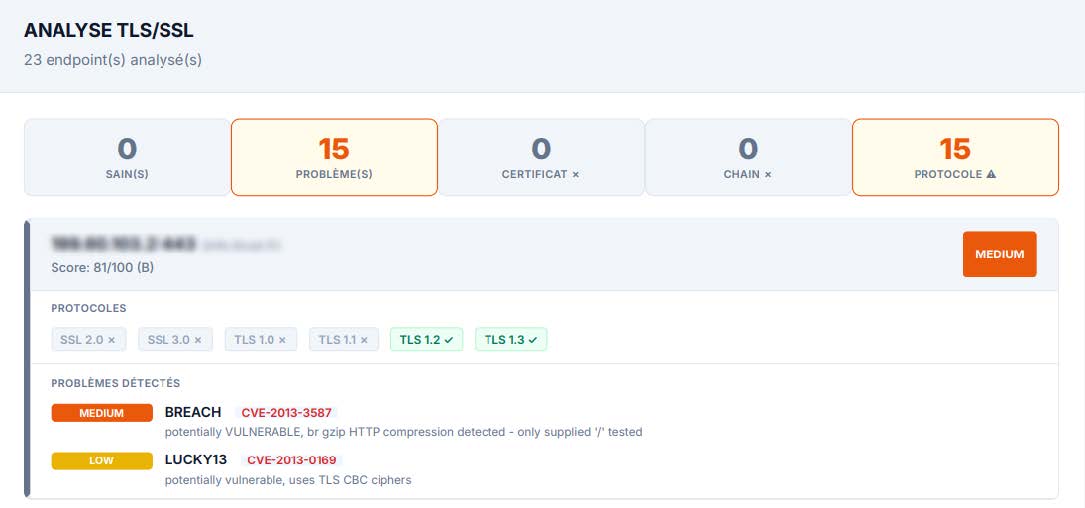
For instance, analyzing TLS/SSL configurations enables the identification of deprecated protocols or obsolete cryptographic cipher suites. Similarly, email configuration plays a pivotal role in protecting against identity spoofing and phishing campaigns.
By analyzing these components from the Internet, it becomes possible to detect publicly visible configuration weaknesses, which are frequently leveraged during attack preparation phases.
Valuable visibility for cyber governance
External attack surface analysis goes beyond purely technical considerations. It also forms an integral part of managing security posture.
The report generated by the scanner thus provides an actionable baseline for:
-
security audits,
-
tracking exposure over time,
-
internal reporting to IT teams or executive leadership.
This ability to transform technical observations into strategic management indicators becomes a valuable asset in cyber risk management.
Contact us
An initial consultation with our team will allow us to fully understand your requirements and provide you with a tailored quote.