
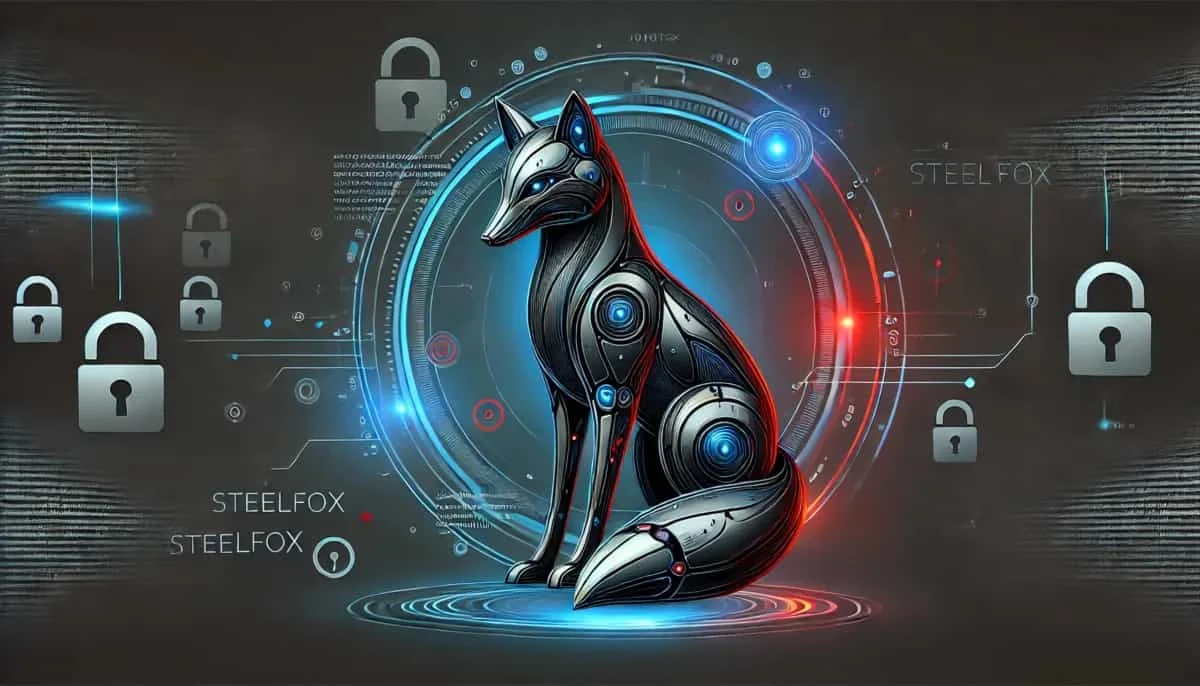
In current cyber news, one name is sparking both curiosity and concern: Steelfox. This malware, with an enigmatic name combining the strength of steel and the cunning of a fox, perfectly embodies its nature: stealthy, resilient, and remarkably effective. But where does this malicious program come from? Its origins raise as many questions as theories. To understand this threat in all its complexity and anticipate its next moves, our cybersecurity experts break it down.
Chronological overview of the malware
First spotted in 2023, SteelFox has demonstrated rapid propagation and continuous development:
February 2023: Initial identification. SteelFox is spotted for the first time. It spreads via illicit activation tools for popular software, distributed across forums and torrent sites.
March 2023: First technical analyses. Researchers uncover the use of the vulnerable driver WinRing0.sys to escalate to system privileges, exploiting vulnerabilities CVE-2020-14979 and CVE-2021-41285. The primary activities identified include sensitive data theft and cryptocurrency mining.
May 2023: Expansion of reach. Attacks primarily impact Brazil, China, Russia, and India, with a significant increase in reported infections.
August 2024: Peak of infections: Researchers observe an evolution in propagation methods aimed at larger-scale distribution. Over 11,000 attack attempts in a single month!
November 2024: Public disclosure and in-depth analyses. Detailed technical analyses are published, unveiling the inner workings of SteelFox.
SteelFox victimology study
SteelFox victims generally share the following behaviors:
- Downloading pirated software: Users illegally download "cracks" or activators via forums, torrent sites, or unofficial blogs. SteelFox targets those seeking pirated (free or cheaper) versions of popular software.
- Browsing habits: Users of browsers such as Chrome, Opera, Firefox, and Brave are particularly targeted.
- Lack of vigilance: They place undue trust in unverified sources, overlooking the risks associated with downloading unofficial software.
- Absence of robust security solutions: These users often lack up-to-date antivirus software or fail to configure it properly, making it easier for SteelFox to infect the system.
SteelFox infections have been detected across multiple countries, notably Brazil, China, Russia, Mexico, the United Arab Emirates, Egypt, Algeria, Vietnam, India, and Sri Lanka. Although France is not explicitly cited in current reports, the global distribution pattern of pirated software suggests that French users could also be exposed to this malware.
The profile of SteelFox malware victims can be segmented into several distinct categories, based on specific behavioral, professional, and geographic characteristics. Here is a detailed breakdown:
| Key characteristics | Targeted software/tools | Specific vulnerabilities | |
|---|---|---|---|
| Individual users |
|
|
|
| Small and Medium-sized Enterprises (SMEs) |
|
|
|
| Large enterprises and multinational corporations |
|
|
|
Components of this cyber threat
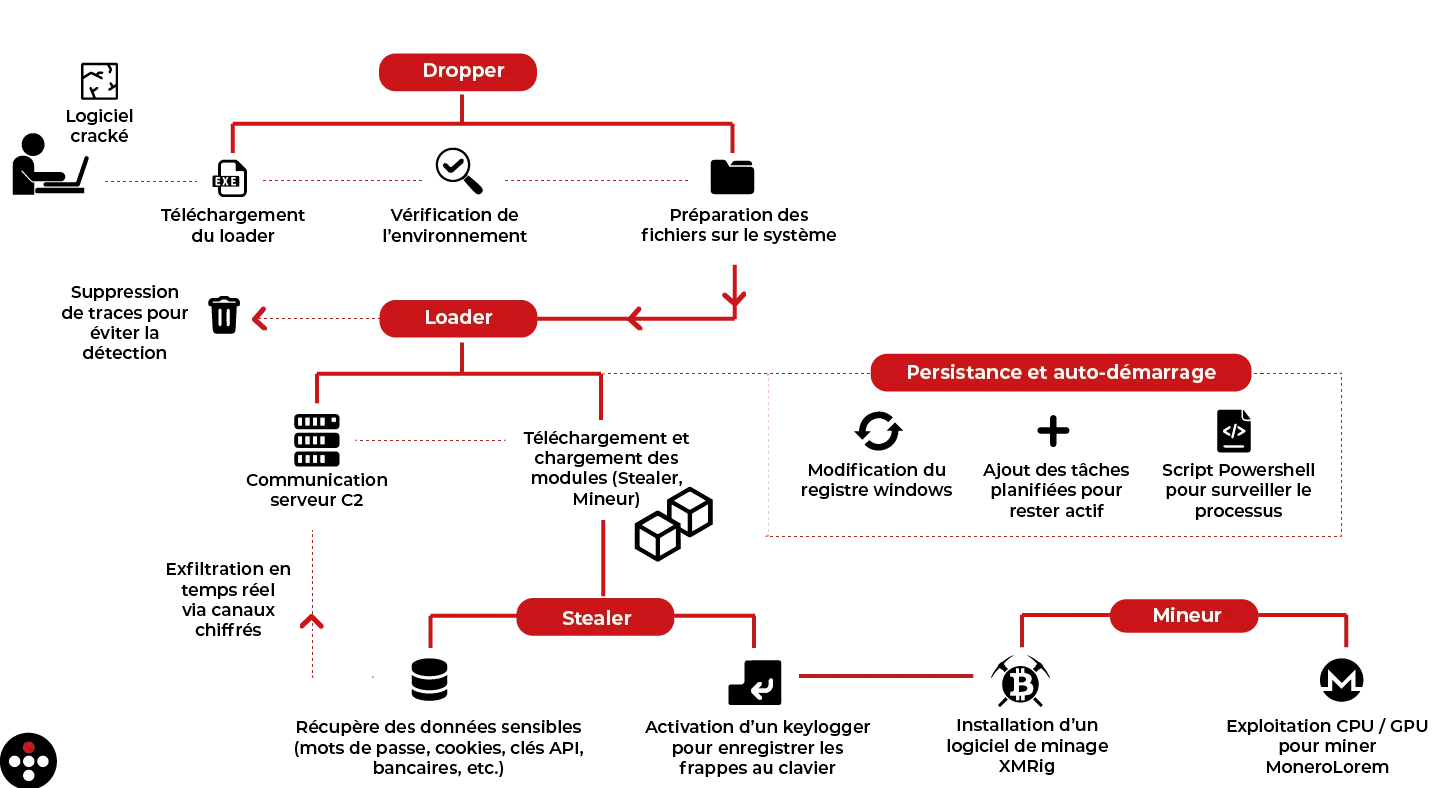
SteelFox is a striking example of the growing complexity of modern malware. Its components operate in synergy, like the core pieces of a puzzle, to ensure an effective and persistent attack. From its dropper to persistence mechanisms that make it exceedingly difficult to eradicate, SteelFox is a case study in malicious ingenuity.
Dropper component: the entry point
SteelFox's infection lifecycle begins with the dropper, a compact yet sophisticated program engineered to infiltrate the target system. Disguised as a legitimate executable or commonly downloaded utility (such as a "crack" or a fake software update), it is frequently executed by the user themselves. Once launched, the dropper silently deploys the loader and subsequent modules into strategic locations, such as system directories or temporary folders. To evade detection, it leverages advanced obfuscation techniques and can actively scan for security tools to adapt its behavior accordingly.
Loader component: the orchestrator
Following initial infiltration, the loader takes over to orchestrate the deployment of malicious payloads. This component is designed to load requisite modules directly into memory without writing them to disk, significantly limiting the forensic footprint detectable by antivirus solutions. It frequently communicates with a Command and Control (C2) server to retrieve additional modules, tailoring the attack to the specific targeted environment. The SteelFox loader can also exploit known vulnerabilities (such as BYOVD) to neutralize host defenses.
Persistence and autostart component: ensuring a sustained presence
Once the loader is deployed, SteelFox implements its persistence and autostart mechanisms, ensuring resilience across system reboots or remediation attempts. Windows Registry keys are manipulated to embed SteelFox into programs executed during system startup. In parallel, scheduled tasks or covert PowerShell scripts allow the malware to automatically reinstall itself in the event of partial detection and removal. This module also monitors system processes to relaunch critical components should a user or security solution attempt to terminate them.
Stealer component: the silent thief
At the core of SteelFox lies the stealer, a module engineered to covertly harvest sensitive information. This component targets an extensive array of data: browser-stored credentials, session cookies, banking details, API keys, and specific files identified through targeted keyword searches. SteelFox relies on encrypted communication channels to exfiltrate this data in real time to its C2 server, mitigating the risk of detection during transmission. This module can also incorporate a keylogger to capture keystrokes—a highly effective technique for capturing credentials on systems secured with complex authentication schemes.
Miner component: silent resource exploitation
The final phase of SteelFox often involves deploying a cryptocurrency miner, such as XMRig, to monetize its prolonged presence on the compromised endpoint. This module harnesses host CPU and GPU resources to mine privacy-centric cryptocurrencies like Monero. To maintain stealth, the miner dynamically throttles its resource consumption based on user activity, pausing when high-demand applications (such as gaming or professional enterprise software) are active. This strategy ensures both operational stealth and optimal exploitation of idle system resources.
6 advanced techniques employed by SteelFox
SteelFox utilizes a wide array of advanced techniques in conjunction with its core components to maximize operational efficiency, bypass security controls, and entrench its persistence. Key mechanisms include:
-
"Bring Your Own Vulnerable Driver" (BYOVD)
SteelFox employs an advanced technique that exploits legitimate yet vulnerable drivers, such as WinRing0.sys, to obtain elevated kernel-level privileges. This approach allows the threat actor to:
- Bypass system defenses: Running with kernel-level privileges, SteelFox gains unrestricted access to critical operating system structures, neutralizing mechanisms like anti-rootkit protections and traditional antivirus engines.
- Deploy secondary payloads: Unrestricted system access allows the threat actor to deploy additional malicious components seamlessly.
- Maintain persistence: Leveraging vulnerable drivers enables the malware to conceal its footprint and persist despite remediation attempts.
This technique is particularly formidable because it repurposes legitimate, signed software for malicious ends, significantly complicating detection for security defenses.
-
Detection evasion
SteelFox embeds sophisticated mechanisms engineered to evade detection by security solutions:
- Analysis environment detection: It actively detects virtualized environments, sandboxes, and debugging tools, adapting its behavior by suspending malicious activity to prevent reverse engineering.
- Process masquerading and injection: By injecting malicious code into legitimate system processes (e.g., svchost.exe), SteelFox conceals its execution from security analysts and endpoint monitoring tools.
These capabilities allow the malware to remain beneath the radar of traditional antivirus and endpoint detection engines.
-
Real-time data exfiltration
Once sensitive assets are gathered (banking credentials, passwords, session cookies), SteelFox exfiltrates them without delay to threat actor-controlled remote infrastructure.
- Encrypted channels: Data is transferred over secure protocols such as HTTPS, rendering inspection and interception difficult for Intrusion Detection Systems (IDS).
- Covert network flows: Outbound traffic blends seamlessly with legitimate network activity to evade active network monitoring controls.
This mechanism ensures stolen assets are rapidly leveraged, significantly reducing the victim organization's window for effective incident response.
-
Modular payload extensibility
SteelFox expands beyond its baseline functionality through modular capabilities, allowing it to:
- Download and execute secondary malware: Depending on the target profile, it can deploy ransomware, banking Trojans, or specialized post-exploitation toolkits.
- Dynamically adapt attack vectors: By establishing command-and-control (C2) communications, SteelFox receives remote instructions to execute tailored malicious actions.
This modularity makes SteelFox a versatile, polymorphic threat capable of adapting to diverse targets and operational contexts.
-
Enhanced resilience
SteelFox uses advanced persistence mechanisms to guarantee sustained access on compromised systems:
- Windows Registry modification: It hooks into critical autorun keys to re-execute automatically upon every system boot.
- Process watchdog monitoring: If a malicious component is terminated by an endpoint security control, SteelFox detects the interruption and automatically restarts the process.
- File redundancy: It reconstructs files quarantined or deleted by antivirus engines using backup copies staged in rarely inspected directories.
-
Forensic countermeasures: evasion and anti-forensics
SteelFox incorporates anti-forensic capabilities to impede incident analysis and forensic investigations:
- Artifact wiping: Following installation, it deletes temporary files and execution artifacts, hindering forensic timeline reconstruction.
- Camouflage: Modules mimic naming conventions and file paths of legitimate operating system binaries, complicating triage and identification.
- Anti-analysis defenses: Modules are frequently packed, encrypted, or obfuscated to resist static reverse engineering by cybersecurity analysts.
How to protect your infrastructure against malware like SteelFox
To effectively defend against SteelFox, organizations should implement the following recommendations:
- Only download and execute software originating from verified, official sources.
- Keep your operating system and applications up to date.
- Enforce rigorous access control policies and prioritize least-privilege accounts.
- Integrate security solutions beyond basic antivirus. A standard antivirus or anti-malware solution can be deployed as an initial layer of defense against known threats.
ITrust offers a comprehensive suite of solutions to safeguard organizations against malware such as SteelFox:
- IKare: detects vulnerabilities that SteelFox could exploit, identifying security flaws and risky configurations across IT networks.
- Reveelium: analyzes abnormal behavior to identify malicious SteelFox activity, even when it employs advanced stealth techniques.
- Dark Web Monitoring : detects traces of SteelFox, particularly the sale of stolen data or discussions regarding new malicious campaigns.
- Managed SOC: delivers continuous monitoring and immediate incident response against SteelFox attacks, mitigating potential impacts.
- Managed EDR: protects workstations and endpoints against malicious SteelFox activities by detecting and blocking its operations in real time.