
In brief, this March 2026, the barrier between exploit capabilities reserved for nation-state actors and organized cybercrime has collapsed. The simultaneous disclosure of two complete iOS exploit kits, Corona and DarkSword, within a single month signals market saturation for mobile vulnerabilities.
DarkSword, a "full-chain" exploit written in JavaScript, enables the complete takeover of iOS devices (versions 18.4 to 18.7) with minimal user interaction. Deployed by suspected state-sponsored actors (UNC6353) and commercial surveillance vendors (PARS Defense, UNC6748), this kit illustrates a critical trend: the modularity and ease of deployment of high-tier offensive tools.
For CISOs and CIOs, the threat is no longer theoretical. It actively targets unpatched mobile fleets via watering hole attacks. This article details the technical anatomy of DarkSword, maps the threat actors involved, and outlines mandatory mitigation measures.
1. Technical anatomy of the exploit chain
Unlike traditional persistent spyware (e.g., Pegasus), DarkSword favors a "hit-and-run" approach. The goal is not ongoing surveillance, but rather the massive exfiltration of sensitive data within minutes, followed by artifact wiping to minimize forensic detection.
1.1. Infection vector: watering hole and fingerprinting
The infection begins when visiting a compromised web page via Safari. A malicious iFrame element loads a JavaScript script designed to fingerprint the device.
- Target: iOS devices running specific versions (18.4 to 18.6.2 for UNC6353; up to 18.7 for other actors).
- Mechanism: If the device matches the profile, the script redirects the browser to the exploit chain.
1.2. The vulnerability chain (6 CVEs)
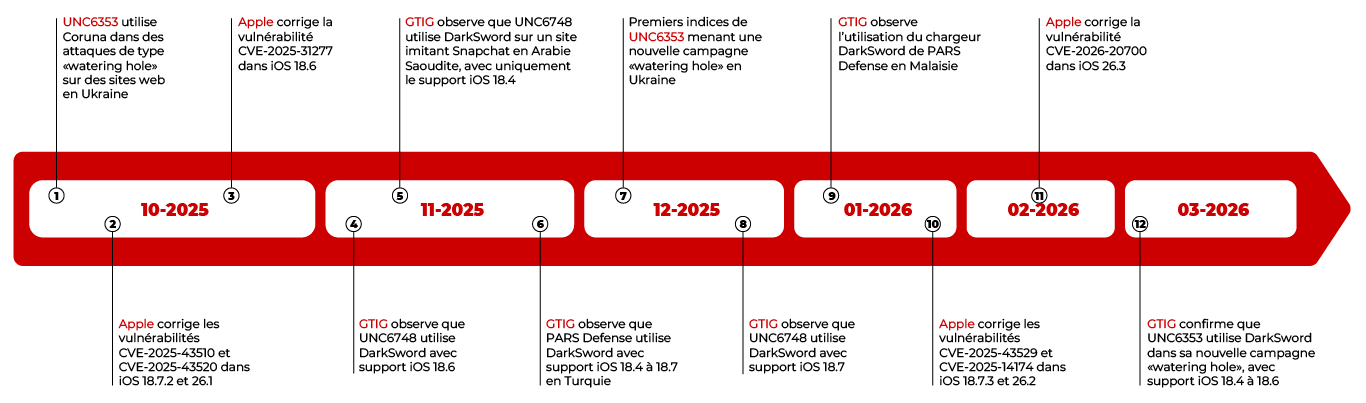
DarkSword chains six distinct vulnerabilities to break through iOS security layers. Three of them were zero-days at the time of active exploitation.
| Stage | Component | CVE | Vulnerability Type | Zero-Day Status | Apple Patch |
|---|---|---|---|---|---|
| RCE | JavaScriptCore | CVE-2025-31277 | Memory corruption | No | iOS 18.6 |
| RCE | JavaScriptCore | CVE-2025-43529 | Memory corruption (DFG JIT) | Yes | iOS 18.7.3 / 26.2 |
| PAC Bypass | dyld | CVE-2026-20700 | PAC Bypass (User Mode) | Yes | iOS 26.3 |
| Sandbox Escape 1 | ANGLE (WebGPU) | CVE-2025-14174 | Memory corruption | Yes | iOS 18.7.3 / 26.2 |
| Sandbox Escape 2 | Kernel (XNU) | CVE-2025-43510 | Memory management (CoW) | No | iOS 18.7.2 / 26.1 |
| Kernel LPE | Kernel (VFS) | CVE-2025-43520 | Memory corruption | No | iOS 18.7.2 / 26.1 |
1.3. Sandbox escape mechanics
DarkSword's sophistication lies in its ability to pivot between sandboxed processes, thereby circumventing code execution restrictions:
- WebContent → GPU: Exploitation of CVE-2025-14174 via WebGPU to break out of Safari's rendering sandbox.
- GPU → mediaplaybackd: Exploitation of CVE-2025-43510 to inject code into mediaplaybackd, a system daemon handling multimedia playback with elevated privileges.
- Kernel escalation: exploitation of CVE-2025-43520 to achieve arbitrary read/write primitives in kernel memory.
Once these steps are completed, the kit loads additional JavaScript modules (GHOSTBLADE, GHOSTKNIFE, GHOSTSABER) capable of accessing restricted areas of the file system.
2. Threat analysis: threat actors, motivations, and market
Analysis of the DarkSword campaign highlights a fragmentation of threat actors and the porous nature of offensive tooling.
2.1. Mapping of identified threat actors
| Cluster | Attribution | Geographic Targets | Payload | Likely Motivations |
|---|---|---|---|---|
| UNC6353 | Russian APT / Proxy | Ukraine | GHOSTBLADE | Intelligence / Crypto Theft |
| UNC6748 | Surveillance Vendor | Saudi Arabia | GHOSTKNIFE | Commercial Surveillance |
| PARS Defense | Turkish Vendor | Turkey, Malaysia | GHOSTSABER | Commercial Surveillance |
- UNC6353: also linked to the Corona tool. This group uses watering hole attacks on compromised Ukrainian websites. Their OPSEC (operational security) is assessed as weak by Lookout: lack of obfuscation in the JavaScript code, obvious file naming, simple file drop endpoints. This suggests either access to powerful tools without strong in-house engineering, or operational negligence.
- Commercial vendors (UNC6748, PARS): targeted use via thematic websites (e.g., snapshare[.]chat for UNC6748).
2.2. Payload analysis: GHOSTBLADE
The primary module observed, GHOSTBLADE, is an infostealer written in JavaScript. This technical choice is notable:
- Modularity: enables rapid development of new modules without native recompilation.
- Bypass capability: facilitates code execution within a restricted environment (PPL/SPTM) once privileges have been escalated.
- Data targeting: the malware heuristically scans for crypto-asset related terms ("metamask", "ledger", "binance", "phantom"), indicating a potential financial motivation alongside intelligence gathering.
2.3. Exfiltrated data
Once privileges are gained, DarkSword extracts and transmits the following data via HTTPS to an external C2 server:
- Communications: emails, SMS, iMessages, call history.
- Identity: contacts, photos, location history, SIM data.
- Sensitive data: saved passwords, Wi-Fi configurations, Safari cookies, iCloud Drive files.
- Financial: data from exchange applications and crypto wallets.
- System: list of installed applications, Apple Health and Notes data.
Following exfiltration (lasting a few seconds to a few minutes), the malware cleans up temporary files and logs to minimize its forensic footprint.
3. Strategic implications for enterprise security
The discovery of DarkSword, coupled with Corona, validates the hypothesis of a secondary market for iOS exploits. Resource-constrained groups can now acquire "high-end" capabilities previously restricted to intelligence agencies.
3.1. Enterprise risks
- Expanded attack surface: attacks are no longer solely targeted (individual spear-phishing), but opportunistic via compromised websites (watering holes), potentially impacting hundreds of millions of unpatched devices.
- Complex detection: the absence of persistence and automated cleanup make post-incident detection challenging using traditional forensic methods.
- Theft of corporate secrets: access to emails, iCloud files, and passwords directly compromises access to enterprise assets (SSO, VPN, Cloud).
3.2. Mitigation recommendations (CISO / CIO)
A. Patch management (critical priority)
All vulnerabilities in the DarkSword chain have been remediated. Patch deployment lead time is the only effective defense against mass exploitation.
- Action: enforce an update to iOS 18.7.3+ / 26.2+ (or the latest available release) via MDM.
- SLA : réduire le délai de déploiement des correctifs de sécurité critiques à < 72 heures pour les profils à risque.
- Target: iOS versions 18.4 to 18.6.2 are confirmed vulnerable.
B. Hardening: Lockdown Mode
For high-risk personnel (executives, finance, R&D, journalists):
- Action: enable Lockdown Mode (Settings > Privacy & Security > Lockdown Mode).
- Impact: this mode disables advanced WebKit features and unauthorized wired connections, technically neutralizing the exploitation vectors used by DarkSword.
C. Detection and Response (SOC)
- Web Monitoring: Block known domains (e.g., static[.]cdncounter[.]net, sqwas[.]shapelie[.]com) at the DNS or proxy level.
- Device Logs: Monitor correlated crashes across the com.apple.WebKit.WebContent, com.apple.WebKit.GPU, and mediaplaybackd processes within a short time window.
- Network Traffic: Identify anomalous outbound HTTPS connections from system processes to unlisted IPs/domains.
D. Targeted Awareness
- Educate high-risk users on the risks associated with web browsing (watering hole attacks).
- Recommend the use of alternative browsers with enhanced security controls (although WebKit is mandated on iOS, protection layers vary).