
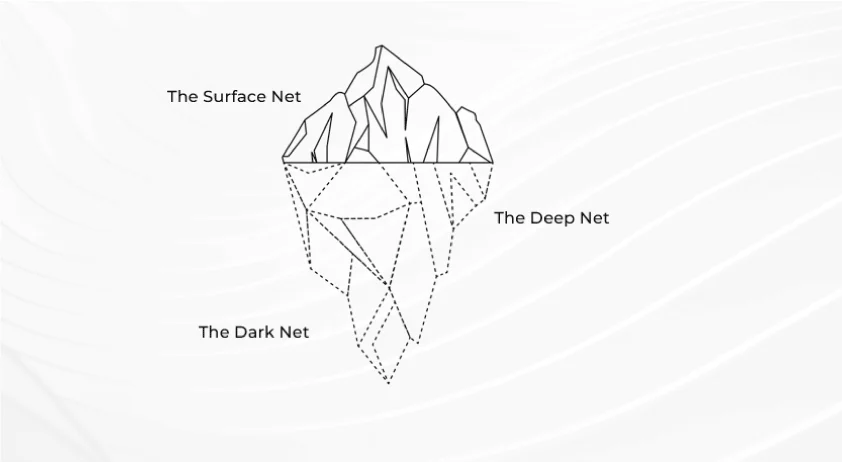
The distinction between the Deep Web and the Dark Web is essential for any cybersecurity expert. These terms are often confused, but they refer to very different parts of the Internet. While the entire Dark Web is part of the Deep Web, the reverse is not true. Before exploring the Deep Web and the Dark Web, it is important to distinguish the Internet from the web. Often confused, these terms are distinct. The Internet is a global network of computers that emerged in the 1970s, accessible through various means such as FTP and VoIP telephony. The web, invented by Tim Berners-Lee in the early 1990s, uses hypertext to enable navigation between pages. Today, it is the most commonly used application for searching information on the Internet.
What is the Deep Web?
The Deep Web includes all parts of the Internet that are not indexed by standard search engines like Google, Bing, and Yahoo. Contrary to popular belief, the majority of the Deep Web is entirely legal and often used for privacy and security reasons. In fact, it accounts for the vast majority of information available on the Internet. Unlike the surface web, the Deep Web contains web pages and databases that are accessible only through specific means, often protected by passwords or other security controls. The Deep Web encompasses a broad range of content, from academic databases, medical records, and internal financial reports to private online libraries, email accounts (such as Gmail, Yahoo Mail), online data repositories (such as JSTOR, LexisNexis), private forums, and social networks with strict privacy settings.
What is the Dark Web?
The Dark Web is a subset of the Deep Web that is intentionally concealed and accessible only through specialized software, such as Tor (The Onion Router). Unlike the Deep Web, the Dark Web is frequently associated with illegal activities due to the anonymity it provides and the difficulty of monitoring it. On the Dark Web, one can find black markets (e.g., Silk Road), hacker forums, money laundering services, and other illicit activities. However, it is important to note that the Dark Web is not used exclusively for unlawful purposes; journalists, activists, and individuals living under authoritarian regimes may use it to communicate securely and bypass censorship.
Proactive Monitoring
It is essential for any organization to adopt a proactive approach to monitoring the Dark Web. For example, Dark Web monitoring is critical to track and identify malicious activities. To learn more, you can consult our Dark Web Monitoring offering.